

For Sellers
Save Time and Effort by Selling with an Agent

Selling a house is a time-consuming process – especially if you decide to do it on your own, known as a For Sale By Owner (FSBO). From conducting market research to reviewing legal documents, handling negotiations, and more, it’s an involved and highly detailed process that requires a lot of expertise to navigate effectively. That’s one of the reasons why the percentage of people selling their own house has declined from 19% to 8% (See graph below):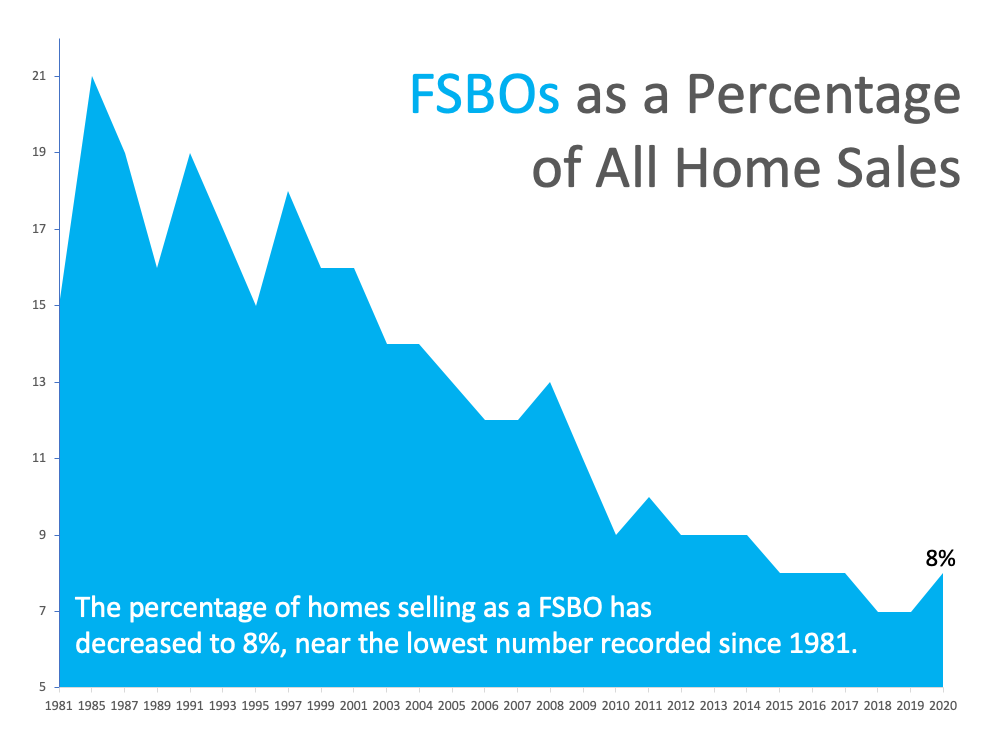 To help you understand just how much time and effort it takes to sell on your own, here’s a look at a few of the things you need to think about before putting that “For Sale” sign up in your yard.
1. Making a Good First Impression
While it may sound simple, there are a lot of proven best practices to consider when prepping a house for sale.
- Do you need to take down your personal art?
- What’s the right amount of landscaping to boost your curb appeal?
- What wall colors are most appealing to buyers?
If you do this work on your own, you may invest capital and many hours into the wrong things. Your time is money – don’t waste it. An agent can help steer you in the right direction based on current market conditions to save you time and effort. Since we’re in a hot sellers’ market, you don’t want to delay listing your house by focusing on things that won’t change your bottom line. These market conditions may not last, so lean on an agent to capitalize on today’s low inventory while you can.
2. Pricing It Right
Real estate professionals have mission-critical information on what sells and how to maximize your profit. They’re experienced when it comes to looking at recent comparable homes that have sold in your area and understanding what price is right for your neighborhood. They use that data to price your house appropriately, maximizing your return.
In a FSBO, you’re operating without this expertise, so you’ll have to do your own homework on how to set a price that’s appropriate for your area and the condition of your home. Even with your own research, you may not find the most up-to-date information and could risk setting a price that’s inaccurate or unrealistic. If you price your house too high, you could turn buyers away before they’re even in the front door, or run into problems when it comes time for the appraisal.
3. Maximizing Your Buyer Pool (and Profit)
Contrary to popular belief, FSBOs may actually net less profit than sellers who use an agent. One of the factors that can drive profit up is effective exposure. Simply put, real estate professionals can get your house in front of more buyers via their social media followers, agency resources, and proven sales strategies. The more buyers that view a home, the more likely a bidding war becomes. According to the National Association of Realtors (NAR), the average house for sale today gets 5 offers. Using an agent to boost your exposure may help boost your sale price too.
4. Navigating Negotiations
When it comes to selling your house as a FSBO, you’ll have to handle all of the negotiations. Here are just a few of the people you’ll work with:
- The buyer, who wants the best deal possible
- The buyer’s agent, who will use their expertise to advocate for the buyer
- The inspection company, which works for the buyer and will almost always find concerns with the house
- The appraiser, who assesses the property’s value to protect the lender
As part of their training, agents are taught how to negotiate every aspect of the real estate transaction and how to mediate potential snags that may pop up. When appraisals come in low and in countless other situations, they know what levers to pull, how to address the buyer and seller emotions that come with it, and when to ask for second opinions. Navigating all of this on your own takes time –a lot of it.
5. Juggling Legal Documentation
Speaking of time, consider how much free time you have to review the fine print. Just in terms of documentation, more disclosures and regulations are now mandatory. That means the stack of legal documents you need to handle as the seller is growing. It can be hard to know and truly understand all the terms and requirements. Instead of going at it alone, use an agent as your shield and advisor to help you avoid potential legal missteps.
Bottom Line
Selling your house on your own is a lot of responsibility. It’s time consuming and requires an immense amount of effort and expertise. Before you decide to sell your house yourself, let’s discuss your options so we can make sure you get the most out of the sale.

Summer’s winding down, and if you’ve been thinking about selling, you might be wondering if you missed your chance. Better to wait until next year or even next spring, right?
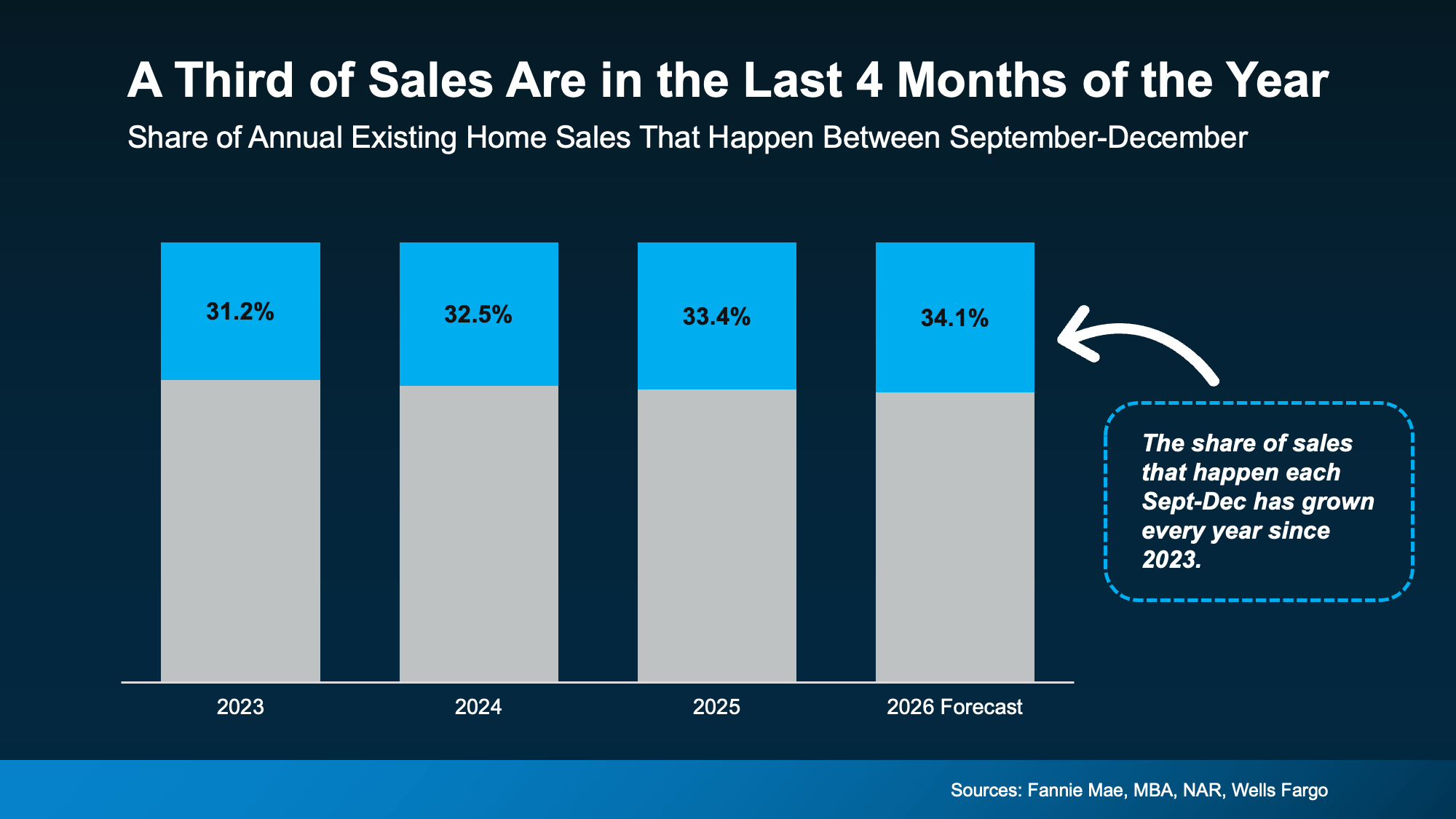
Not so fast. About one in three of all home sales happen in the last four months of the year.
Fall Is Busier than You Think
Data from the National Association of Realtors (NAR) shows around a third of existing home sales happen in the final four months of the year. And that share has grown every year since 2023 (see graph below):
Here’s What That Means for You
According to forecasts from Fannie Mae, the Mortgage Bankers Association (MBA), NAR, and Wells Fargo, there will be about 4.16 million existing home sales this year. Based on how many sales have happened so far, that means roughly 1.4 million sales are expected between now and December.
That’s about 11,800 houses selling every single day this fall.
So, the market isn’t frozen and you don’t need to put your plans on ice either. Yes, higher rates are keeping some buyers on the sidelines. But hold out for next spring, and you’ll sit out months when other serious buyers are ready to move before the new year.
How do you get in front of those buyers who are still out there looking right now? Getting your house sold this season comes down to how well it’s priced and presented, and that’s where a local agent shines.
A good agent knows what buyers in your area want right now, prices your house to match this fall’s market, and positions it to stand out to the serious buyers shopping before year-end. From the first photo to the final offer, they handle the details that turn your house on the market into one of the 11,800 selling every day.
Bottom Line
Listing this fall doesn’t mean your house will sit on the market until spring. Buyers are out there right now, ready to make a move before the new year – and your window is still open.
To make yours one of the homes that sells this season, connect with a local real estate agent.
Data centers probably weren’t on your list of things to think about when buying or selling a home.
School districts? Sure. How close you are to family? Absolutely. A large building full of computer servers down the road? Probably not.
But that may be changing.
Data centers are popping up in more communities across the country. And as they do, buyers and homeowners are starting to wonder what having one nearby could mean for everything from home values to utility bills. So, let’s get into what the data actually says. Because there’s a lot more nuance here than if they’re “good” or “bad.”
Data Centers Are Showing Up in a Lot More ZIP Codes
According to Realtor.com, back in 2015, only about a dozen ZIP codes had a large data center. But by the first half of 2026, that number had climbed to more than 100 – and it’s projected to rise even further by the end of the year (see graph below):
 That’s a pretty dramatic increase in just over a decade. HousingWire shows a lot of that growth is in Texas, Virginia, Georgia, Pennsylvania, Ohio, Utah, Illinois, Arizona, Indiana, and Nevada.
And that ramp up explains why this is becoming a real estate conversation. More buyers are going to encounter a data center during their search. More homeowners are going to hear about one being proposed nearby.
And both groups are going to want to know what that could mean for them.
The Big Question: What About Home Values?
One of the first concerns homeowners and buyers may have is: could a nearby data center hurt home values? So far, there’s no evidence that says it automatically will.
Researchers compared communities that have large data centers to similar communities without them. A recent HousingWire article reports:
“. . . home values in data center ZIP codes generally tracked their matched communities — with no statistically meaningful gains or losses. Listing prices showed a modest initial increase around openings . . .”
That’s important context. Historically, simply having a data center nearby hasn’t been enough to send home values dramatically higher or lower.
That doesn’t mean every property will react the same way. Proximity, the surrounding development, and the specific facility can all matter. But for the typical homeowner or buyer, the data so far doesn’t point to an automatic impact on home values.
Living Near a Data Center Can Come with Tradeoffs
Like any major development coming to town, data centers can bring benefits along with things buyers and homeowners will want to consider.
On the plus side:
-
They may be part of a bigger growth story. A data center can usher in broader development in an area and substantial property tax revenue that can be used to improve the community.
-
Infrastructure may get an upgrade. New roads, fiber, power infrastructure, and other improvements can come along with major development.
-
They can generate economic activity. A data center can generate jobs which in turn fuels local housing demand and supports local businesses.
On the flip side:
-
They’re not exactly invisible. Large facilities, transmission lines, substations, and construction can change the look and feel of an area.
-
Noise can matter. Cooling equipment, generators, construction, and truck traffic may be noticeable depending on how close you are.
-
They use more resources. These facilities can require significant electricity and, depending on the cooling system, water. That can raise questions about local infrastructure and whether growing electricity demand could affect what residents pay.
On that last point, J.P. Blackwood, Public Affairs Liaison and Media Spokesperson for the Ohio Consumers’ Counsel (OCC), explained his take on what consumers need to know about data centers and their potential to impact utility costs to HousingWire:
“Utility rate increases tend to be gradual, and so that’s what I would expect here. Again, a number of factors can drive electricity prices higher and are driving them higher, and this is one of them. There are steps being taken around the country to mitigate the effects of data centers.”
Basically, they’re just one factor that can have an impact. And the key word there is “can” because it depends on where you live and what rules are in place in your area.
So, What Should Buyers and Homeowners Do?
If you’re buying, find out what’s already there – and what’s approved or proposed nearby. Consider the facility’s proximity, potential noise, future development, and whether utility costs are something you want to factor into your budget.
If you’re selling, don’t assume a nearby data center automatically hurts your home’s value. But buyers may have questions. Knowing the facts about the facility, construction timeline, noise, and future plans can help you address those concerns upfront.
Bottom Line
As more data centers pop up, they’re becoming another piece of the puzzle buyers and homeowners need to understand.
Have a data center nearby or one coming soon? Talk to a local real estate agent about what it could mean for your home or your next move.
Ask a couple people how the housing market is doing and you’ll probably get a couple different answers. That’s because right now, the market runs on 2 very different tracks, split by price point.
Knowing which track your house is on changes everything about your sale, from your asking price to how long you can expect to wait before an offer comes in. Here’s what you need to know.
Home Sales Are Picking Up Speed at the Top of the Market
Rates and buyer competition are shaping this market differently depending on price point. Look at recent sales data from the National Association of Realtors (NAR) and the pattern jumps right out.
Homes priced under $250,000 saw sales drop 2-3% compared to last year, while homes priced above $750,000 saw sales climb by double digits (see graph below):
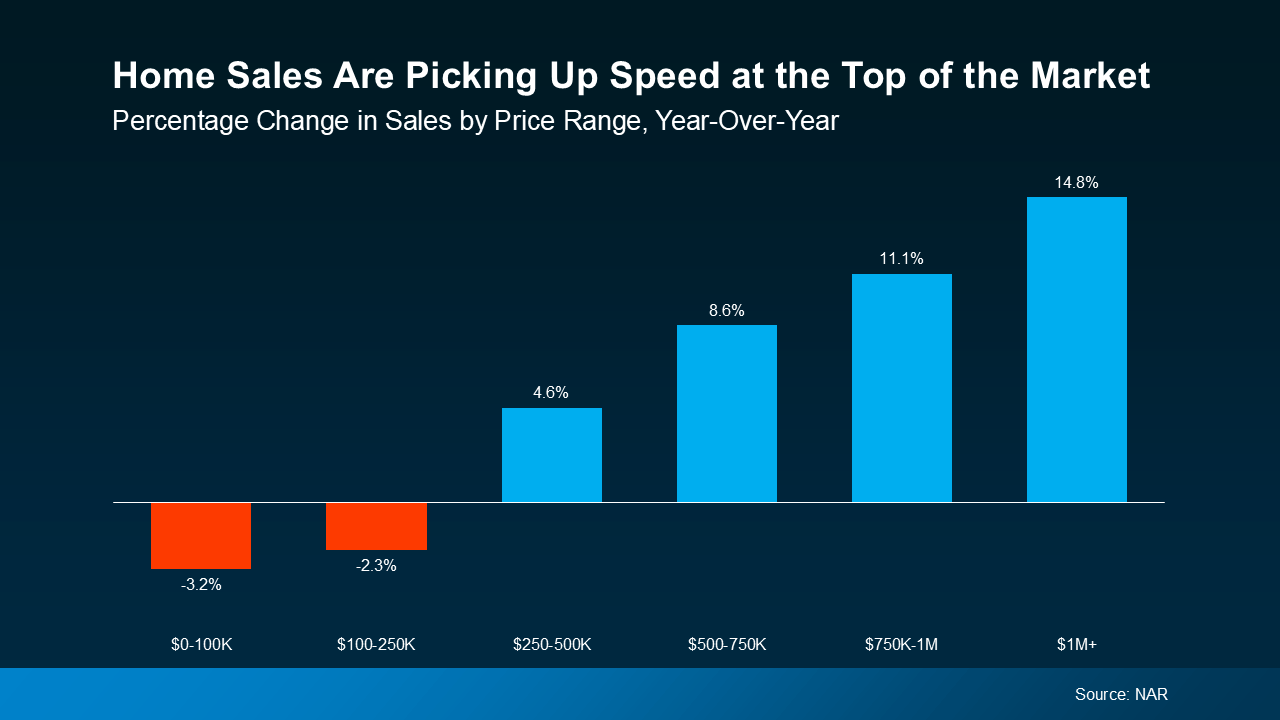 What’s behind the divide? Due to higher rates and the last few years of home price appreciation, fewer buyers can comfortably afford homes at the entry-level price point right now – especially first-time buyers. So, demand in that segment has slowed down.
On the flip side, buyers looking for higher-priced homes have less sensitivity to high-rate environments and more room in their budgets, thanks in part to a strong stock market and their equity in their current home.
That’s the real differentiator. Lower-priced homes are still selling, just not as quickly since today’s rates have shrunk the pool of buyers who can afford to buy their first place right now.
This is exactly why pricing strategy and presentation carry more weight than they used to, especially if you’re selling in that range. Price it right from the start instead of testing a high number, make sure it shows well online and in person, and lean on an agent who can get your listing in front of every buyer shopping in your range. That’s the best way to make sure you catch the attention of one of the buyers who are still looking – and it’s how you prove your home is worth it’s price.
Why Some Homes Sit While Others Get Snapped Up
How fast a home sells is shifting by price point too, and the split is just as sharp. For years, luxury homes sat on the market a lot longer than starter homes. That gap has nearly closed, according to Redfin (see chart below):
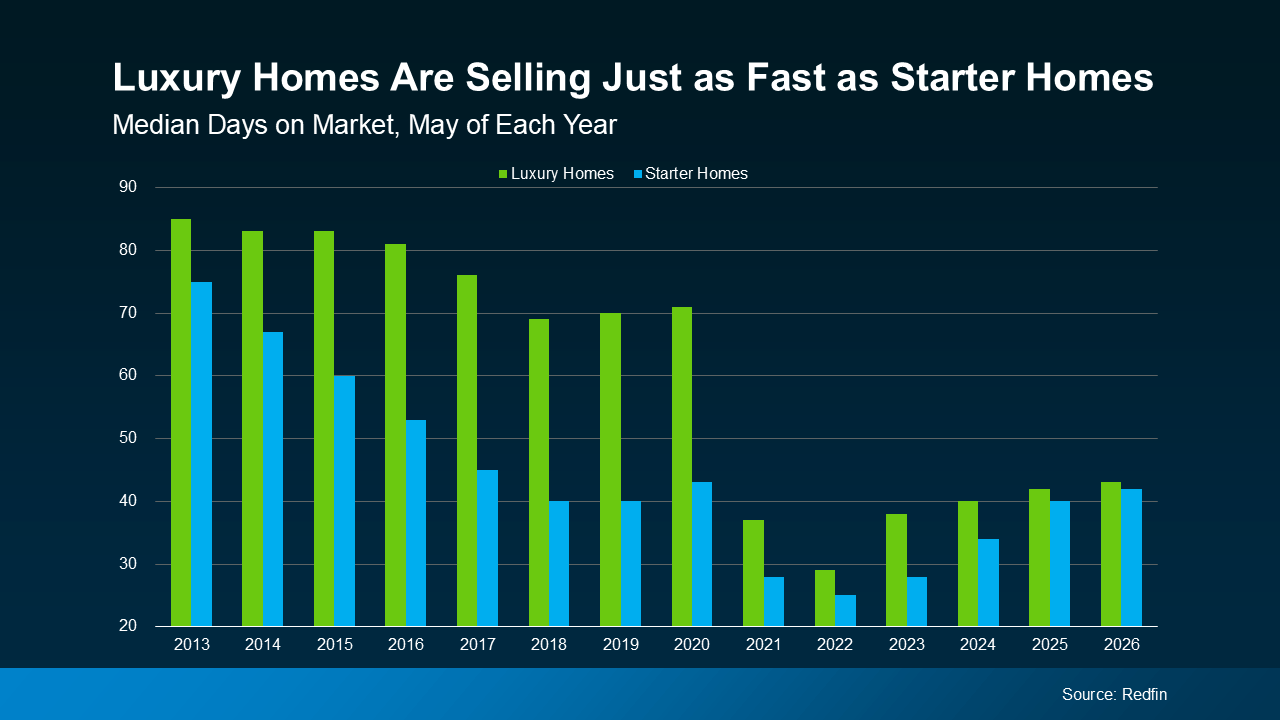 Buyers with deep pockets are moving fast when a well-priced home in their range comes up. As Zillow puts it:
“The U.S. housing market is splitting in two. Luxury homes are selling at a faster pace than a year ago, with shrinking supply and growing bidding wars.”
If you’re in that range, your house may sell faster than you’d expect. You may even get multiple offers. That kind of competition changes how a listing should be marketed and priced from day 1.
And no matter which side you’re on, that’s information you’re going to want up front if you want to have the smoothest sale possible.
What This Means for Your Sale
If you’re thinking about selling an entry-level home, don’t panic. Homes at your price point are still selling, just at a slower pace than last year. That slower pace means pricing and presentation matter even more right now.
If you’re selling a move-up or luxury house, you’re in a good spot right now. Buyers looking in your price point usually aren’t as affected by today’s rates, so they’re more active, and good listings are drawing real competition.
Either way, your price point is the biggest factor in how fast your house sells and what it sells for.
Bottom Line
Your home’s price point is the real story right now, more than anything you’re hearing in national headlines. Connect with a local real estate agent to map out exactly where your house fits in this split market and build a pricing strategy that gets you the speed and price you’re after.

Selling This Fall? You Haven’t Missed Your Window

Data Centers Are Moving Closer to Homes. What Does That Mean for You?

The Housing Market Split in 2. Which Side Is Your House On?



-

 Downsize4 weeks ago
The Kind of House Buyers Are Willing To Pay More For
-
 Downsize4 weeks ago
One Number Could Change Everything About Your Next Move
-

 For Buyers3 weeks ago
Worried About a Housing Crash? The Numbers Tell a Calmer Story.
-

 For Buyers4 weeks ago
Higher Rates Could Actually Help Housing Supply – Here’s How.
-

 Agent Value3 weeks ago
Most Home Sales Close – Here’s How To Keep Yours on Track
-

 Affordability3 weeks ago
Sellers Are Cutting Prices To Meet Buyers Where They’re At
-

 Affordability2 weeks ago
Thinking About Tapping into Your 401(k) To Buy a Home? Read This First.
-
 Affordability2 weeks ago
Why Buyers Shouldn’t Overlook a Fall Move
You must be logged in to post a comment Login