


For Sellers
How an Agent Helps Market Your House

You’re ready to sell your house. But what do you need most from your real estate agent? Well, the National Association of Realtors (NAR) asked that very question to recent sellers and found one of the top things they were looking for is help marketing their house to potential buyers. Maybe that’s what you need the most help with too.
You expect your real estate agent to write a great description of your house for the listing and pair it with some high-quality photos. But that’s not all you’re going to get when you partner with a great agent.
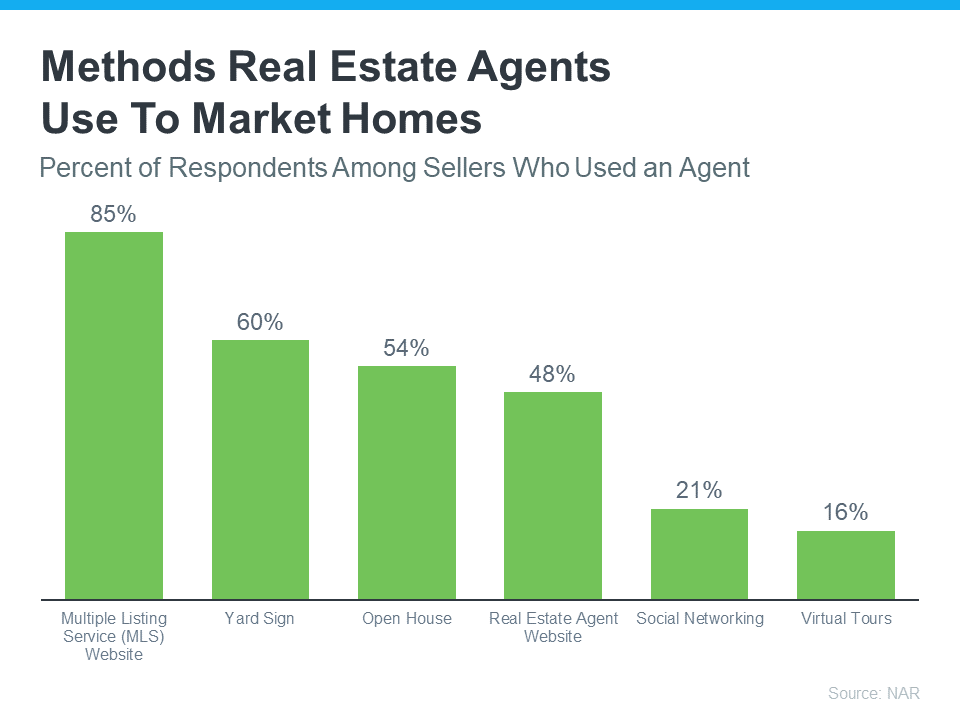
They’ll do a lot more to make sure your house stands out. Here are some of the most common methods real estate agents use to market homes according to that same report from NAR (see graph below):
So, how can you benefit from your agent using these methods?
- Listing on the MLS – By listing your house on the MLS, it will get more visibility from other real estate agents and buyers. This could lead to more traffic, which could ultimately help you see an increase in offers and ultimately a better price.
- Using a Yard Sign – A yard sign catches the eye of people driving or walking by. This method drums up local interest since people who live nearby might have friends or family looking to move into the area. It also prominently displays your agent’s contact information, so interested buyers can get in touch easily.
- Having an Open House – When your agent advertises and hosts your open house, buyers see others are interested in your house, too. This competition can lead to stronger offers. An open house is also easier for you since you only need to leave once for many buyers to visit. Plus, your agent may get useful feedback on what people like or don’t like, which can help you make improvements to attract more buyers later, if needed.
- Showcasing on Your Agent’s Website – Having your house visible on your agent’s website allows for a professional presentation of your property. Additionally, people visiting your agent’s website are more likely to be serious buyers who are ready to make a move.
- Social Networking – Your real estate agent works hard to have a wide-ranging social media presence. Marketing your house this way allows them to reach a large audience. It also makes it easy for people to share your listing with friends and loved ones who might be interested.
- Providing Virtual Tours – Virtual tours are extremely convenient for buyers, especially those who are relocating from out of town. This method allows them to tour anytime, day or night. It shows your agent is using the latest technology to market your house.
There are many tools that can be used to market your house. As NerdWallet sums up:
“A good real estate agent will have a robust plan to promote your listing in an effort to find the right pool of buyers. Adding your home to databases of available homes called multiple listing services (MLS), open houses, 3D virtual tours, professional photography and broker tours for buyers’ agents (particularly for luxury homes) are all factors that may go into a marketing plan.”
As a seller, it’s smart to work with a creative local real estate agent who can maximize them to make sure you get as many eyes on your house as possible.
Bottom Line
When it comes to marketing your house, working with a pro has tons of benefits. If you’re ready to sell, but don’t know where to start, connect with a local real estate agent.

A recent survey from Talker Research asked Americans to pick one word to describe how 2026 has felt so far. The winner? Stressful. And honestly, there’s been a lot going on.
So, it’s understandable if you’ve been putting off buying or selling a home until things settle down. But you may be waiting on something that’s already happened. While everything else has felt shaky, the housing market has become one of the steadiest things out there. Look at the data.
Home Prices Have Leveled Out
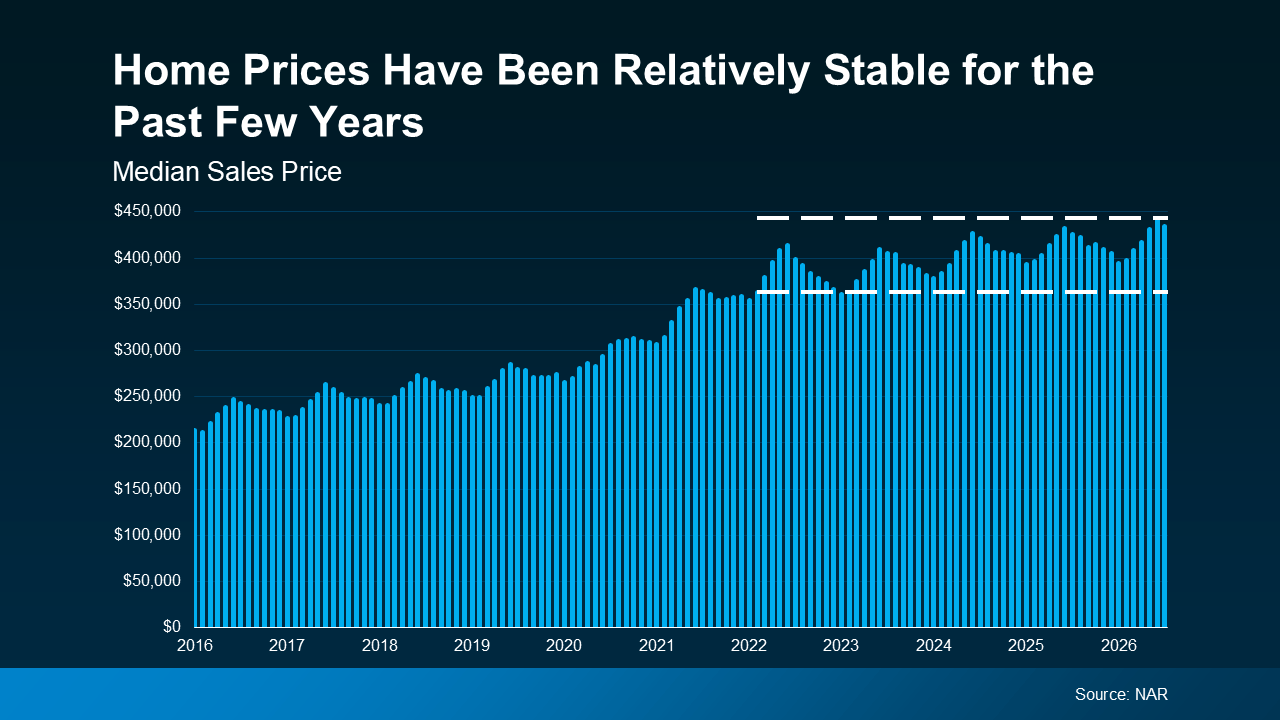
After years of fast increases, data from the National Association of Realtors (NAR) shows home prices have been remarkably steady for the past 4 years (see graph below):
 And experts say that’s what to expect going forward, too. As Selma Hepp, Chief Economist at Cotality, explains:
“In 2026, we expect home prices to remain broadly stable, with modest appreciation at a national level.”
No wild swings. Just slow, steady growth. That’s a healthy market. Of course, that pace can vary a bit depending on where you live. But nationally, steady growth like this makes it easier to plan your budget, whether you’re buying or selling.
The Supply of Homes for Sale Has Steadied
For years, the supply of homes for sale was a moving target. It dropped fast during the pandemic and has been climbing pretty reliably ever since. Now, that pace of growth has slowed down. According to Realtor.com, inventory today is very close to where it was this time last year (see graph below):
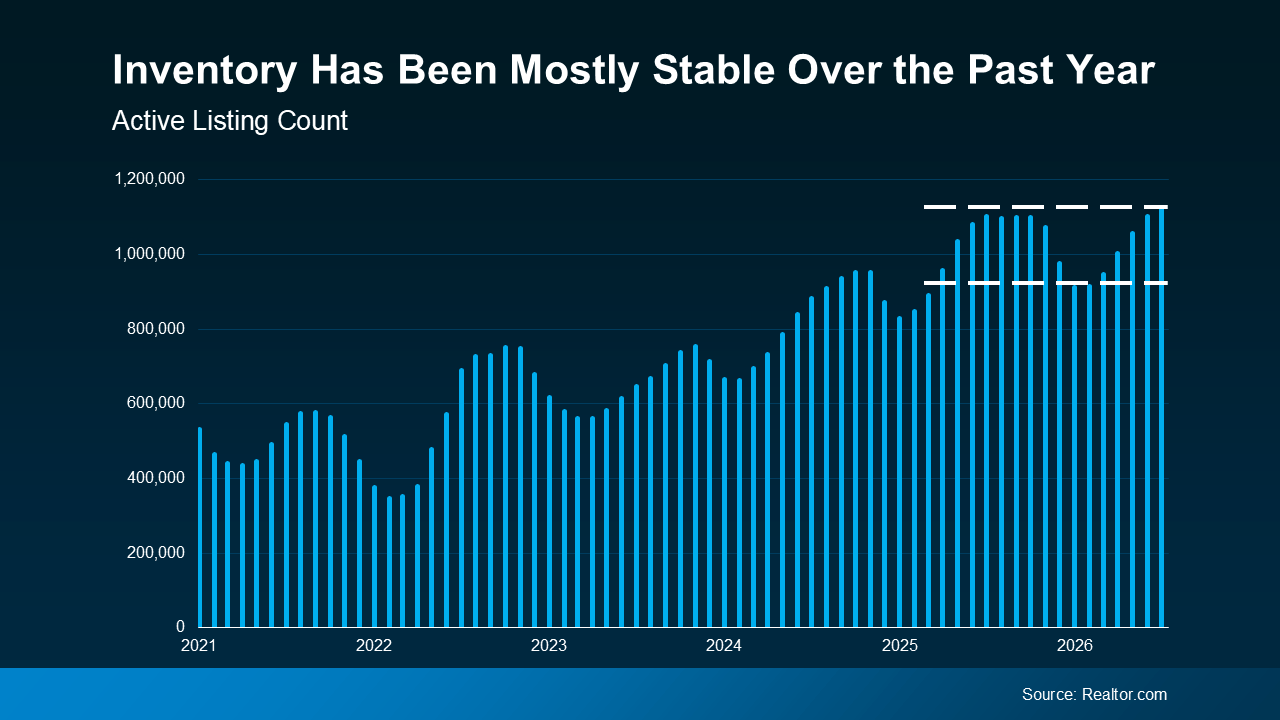 That’s helpful no matter which side you’re on. When the number of homes for sale isn’t changing much, you know what you’re walking into – how many options you’ll have as a buyer, and how much competition you’ll face as a seller.
Mortgage Rates Found Their Range
Yes, rates jumped dramatically back in 2022. But since then, Freddie Mac data shows they’ve stayed between 6% and 7% for the better part of the last 3 or so years (see graph below):
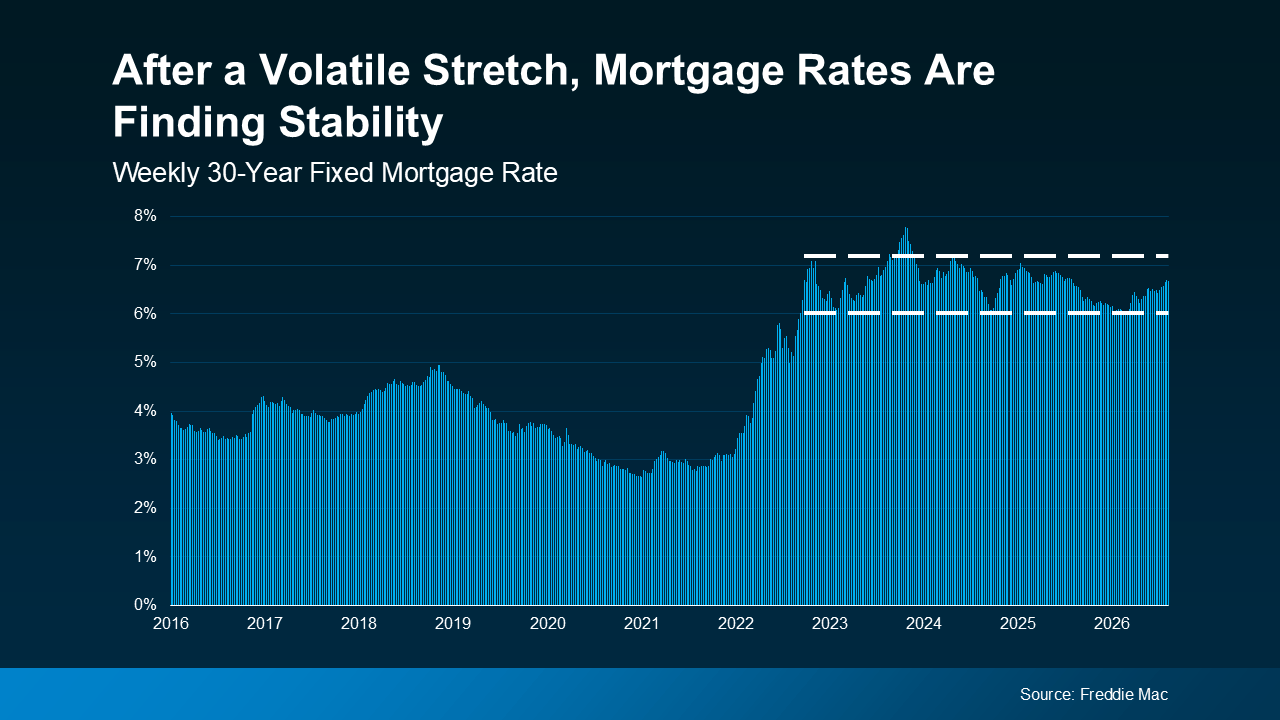 Yes, there was one brief spike above that threshold, but overall, rates have stayed in that range for a while now. That predictability helps when you’re planning a move.
And now that this seems to be a longer-term trend, people have accepted it as the new normal. Buyers have gotten comfortable purchasing in that range, and sellers have gotten just as comfortable listing in it.
That comfort’s important because when both sides know what to expect, they keep making moves. In other words, the market isn’t frozen waiting for something to change. It’s moving calmly.
Bottom Line
The rest of the world may feel unpredictable right now, but the housing market doesn’t have to. Prices, inventory, and rates have all found solid ground.
If stability is what you’ve been waiting for, it’s already here. Connect with a local real estate agent if you want to talk through what that means for your move.

Few things are as rattling as the thought of your home sale falling through at the last minute, right before closing. All that waiting, all that progress, out the window.
But if you’re getting ready to sell, here’s what you should know. Even in today’s market, it rarely comes to that. Buyers who are moving at today’s rates and prices are generally moving because of some big life change. That means they’re motivated, and eager to get all the way to the closing table.
According to the latest data from Redfin, only about 1 in 7 pending sales are falling through. Meaning the vast majority make it all the way to closing.
And the single biggest thing that puts a deal at risk is the one you have the most power to prevent. It just takes a little smart planning before your house hits the market.
Why Some Deals Fall Apart Before Closing
A Redfin survey sheds light on the most common things that trip up a sale (see visual below):
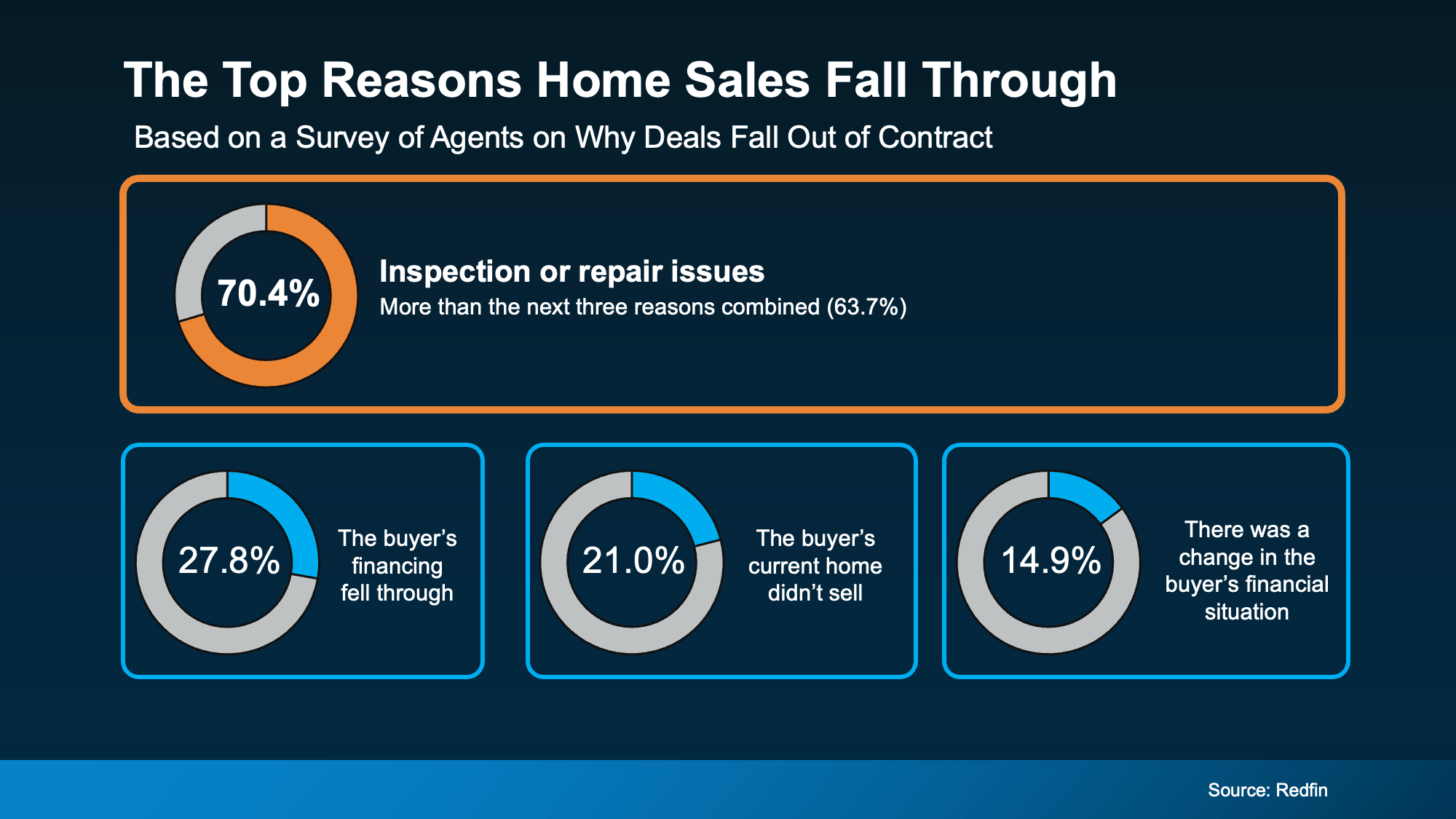
Here’s a bit more information on each one.
-
Inspection or repair issues. This is the big one. When a buyer’s inspector finds a problem, whether with the roof, the plumbing, the foundation, or elsewhere, the buyer can push back, ask you to make repairs, request a credit so they can do it themselves, or see if you’ll lower your price. If they don’t get what they want, they may walk away from the deal altogether.
-
The buyer’s financing fell through. Their mortgage loan has to be fully approved in time for closing day. If the loan doesn’t come together, the sale can’t move forward.
-
The buyer’s current house didn’t sell. Some buyers need to sell their own home before they can close on yours. If that takes longer than expected, you may run into some issues with your timeline or even see them give up on their move.
-
There was a change in buyer’s financial situation. A new job, a big purchase, or new debt can change what a buyer qualifies for on their mortgage loan, even after they were pre-approved.
Where Your Agent Makes the Difference
Some of those reasons are outside your control, like whether a buyer’s loan clears or whether they sell their own home in time. But according to Zillow, there are a few proactive things you can do to help make sure your sale goes as smoothly as possible:
-
Save yourself the headache and get a pre-listing inspection. That’s when you get your own inspection before a buyer gets theirs. It lets you find the big issues before a buyer’s inspector does, so you can fix them or disclose them on your terms, instead of scrambling once you’re under contract. In this situation, your agent will help you decide what’s worth addressing and what to just disclose. Handle it now, and the biggest risk to your sale is behind you before a buyer ever brings it up.
-
Look at more than just the offer price. Your agent will help you weigh the whole offer, including the buyer’s timeline and any contingencies attached. When a buyer’s offer depends on selling their own home first, the success of your sale rides on a second deal you can’t see. Sometimes, a slightly lower offer with fewer strings is the safer one. Your agent will help you weigh your options and make a plan that works well for you.
One of those is something you can’t do until you have offers in hand, but the other is something you can get ahead of right now. The pre-listing inspection.
That relatively small cost upfront can save you the much bigger hassle of a deal falling apart later. And while getting your own inspection before listing may not make sense in every market, your agent can tell you whether it’s worth it based on your market, your house, and what buyers are prioritizing in your area.
Sometimes the smartest move is staying one step ahead.
Bottom Line
Most home sales still close, and the biggest thing that could get in the way of yours is the one thing you can actually do something about.
With the right prep, your sale has every reason to make it to the finish, and a good local agent can help you get there.

When’s the last time someone told you what your house is worth? Not what some online valuation tool guessed. Not what your neighbor’s house sold for. What yours is actually worth right now.
For a lot of homeowners, it’s been years. And if you’ve been thinking about moving, but higher home prices or mortgage rates have made you hesitate, here’s why it’s time to take a second look at that number.
Your House May Be Worth More Than You Think
Home values have climbed significantly over the past 5-10 years. And even though today’s market is more balanced, homeowners are building wealth every day just by owning their homes. That’s how equity works. As home values rise, and as you make your monthly payments, your equity grows. And it adds up fast.
According to Cotality, the typical homeowner with a mortgage now has $310,500 in equity. That’s not a small number. It’s six figures.
And that’s only the national average. In many states, homeowners have built even more equity than that. Take a look at the map below and see where your state stands. The darker the blue, the more equity the typical homeowner has there (see map below):
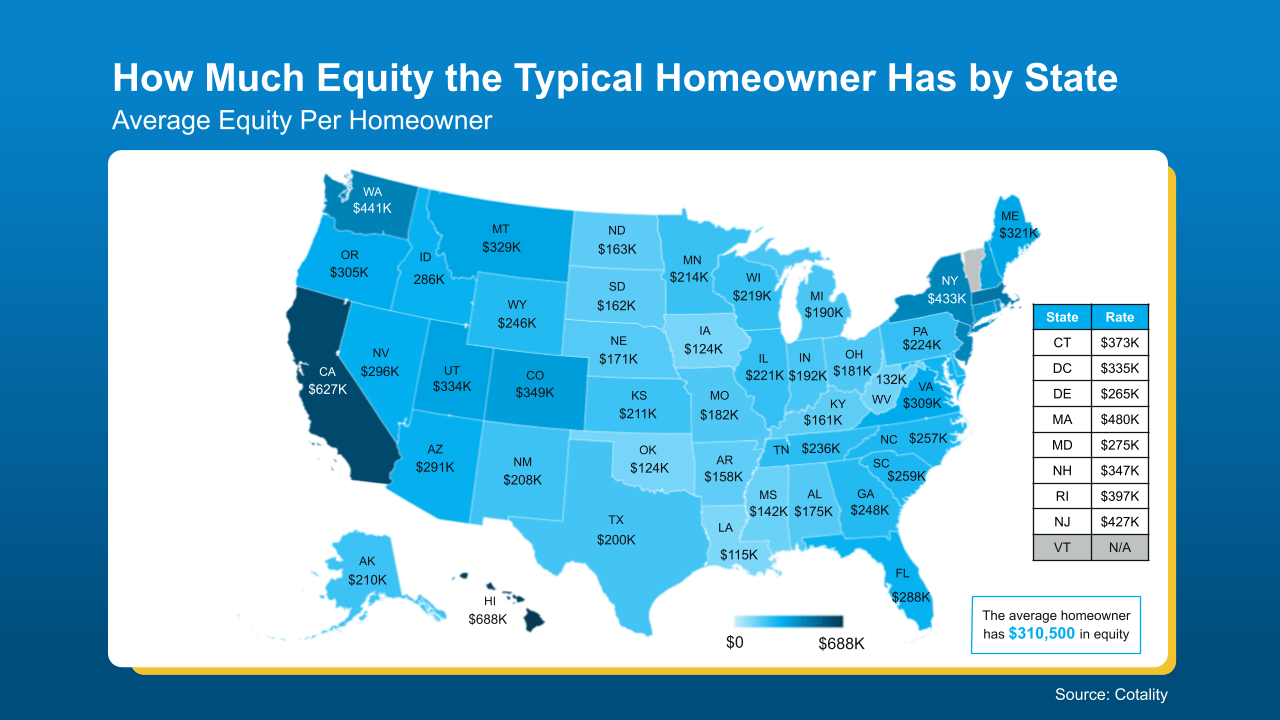 Even though every local market is different, the question you should be asking right now is the same: How much equity have you built up?
Because if you don’t know that number, you’re missing out.
This Could Be the Missing Piece in Your Move
Most people assume that because prices are higher and rates aren’t at 3% anymore, moving just isn’t realistic right now, especially if they already have an ultra-low rate. And that’s understandable – those are real factors.
But they’re not the only factors.
When you have that much equity in your house, you’re not starting from scratch. You’re not scraping together a down payment or hoping the numbers work. You’re walking into your next move with more of an advantage than you think. And that changes the math.
What Your Equity Can Do for You
Maybe you’ve outgrown your current house or you’re ready to downsize… The equity you’ve built could help bridge the gap between where you are today and where you want to be next.
Yes, your next house may cost more than your last one did. But your equity could cover a big chunk of that difference. Depending on how much you’ve built, it could help you:
-
Lower your monthly payment on your next home. The bigger your down payment on your next place, the less you have to borrow. And with today’s rates, borrowing less can make a big difference in what you pay every month.
-
Buy your next house with all cash. This surprises a lot of people, but some homeowners have built enough equity to buy their next home outright, in cash. According to the National Association of Realtors, more than one-quarter (26%) of repeat buyers paid all cash for their home in July.
-
Transform the home you already have. Love your neighborhood but not your floor plan? You don’t have to move. Your equity could help fund renovations that make your home fit your life today while potentially adding value for tomorrow.
Your equity doesn’t erase the challenges of the current market. But it does mean you’re walking into your next move with a lot more power and flexibility than you think.
That’s why the value of your home isn’t something you should have to wonder about.
If you’re even thinking about a move – or if you’re just curious what your options might be – the smartest thing you can do is get a Professional Equity Assessment. It’ll give you a real, market-based evaluation of what your house is really worth right now and how much equity you’re working with.
Because once you see the number, maybe it’s not about whether you can afford to move – it’s about what kind of move makes sense for you.
Bottom Line
If it’s been a while since you’ve gotten a professional look at your home’s value, it’s time to change that.
Reach out to a local real estate agent for a free, personalized Home Equity Assessment that estimates what your house could sell for, how much equity you’ve likely built, and what that could mean for your next move.
You may have six figures of equity without even realizing it. And that’s enough to change everything about your next move.

Remote Work Could Be Your Affordability Answer

Why Buyers Shouldn’t Overlook a Fall Move

Think New Homes Cost More? Not Right Now.



-

 Buying Tips4 weeks ago
Who Has the Upper Hand in Today’s Housing Market?
-

 Downsize3 weeks ago
The Kind of House Buyers Are Willing To Pay More For
-
 Affordability4 weeks ago
Here’s Why Mortgage Rates Are What They Are Right Now
-

 Affordability4 weeks ago
The Case for Putting 20% Down on Your Next Home
-

 Downsize3 weeks ago
One Number Could Change Everything About Your Next Move
-

 For Buyers3 weeks ago
Higher Rates Could Actually Help Housing Supply – Here’s How.
-

 Agent Value2 weeks ago
Most Home Sales Close – Here’s How To Keep Yours on Track
-

 For Buyers2 weeks ago
Worried About a Housing Crash? The Numbers Tell a Calmer Story.
You must be logged in to post a comment Login