
Buying Tips
Unlocking Homebuyer Opportunities in 2024

There’s no arguing this past year has been difficult for homebuyers. And if you’re someone who has started the process of searching for a home, maybe you put your search on hold because the challenges in today’s market felt like too much to tackle. You’re not alone in that. A Bright MLS study found some of the top reasons buyers paused their search in late 2023 and early 2024 were:
- They couldn’t find anything in their price range
- They didn’t have any successful offers or had difficulty competing
- They couldn’t find the right home
If any of these sound like why you stopped looking, here’s what you need to know. The housing market is in a transition in the second half of 2024. Here are four reasons why this may be your chance to jump back in.
1. The Supply of Homes for Sale Is Growing
One of the most significant shifts in the market this year is how the months’ supply of homes for sale has increased. If you look at data from the National Association of Realtors (NAR), you’ll see how inventory has grown throughout 2024 (see graph below): 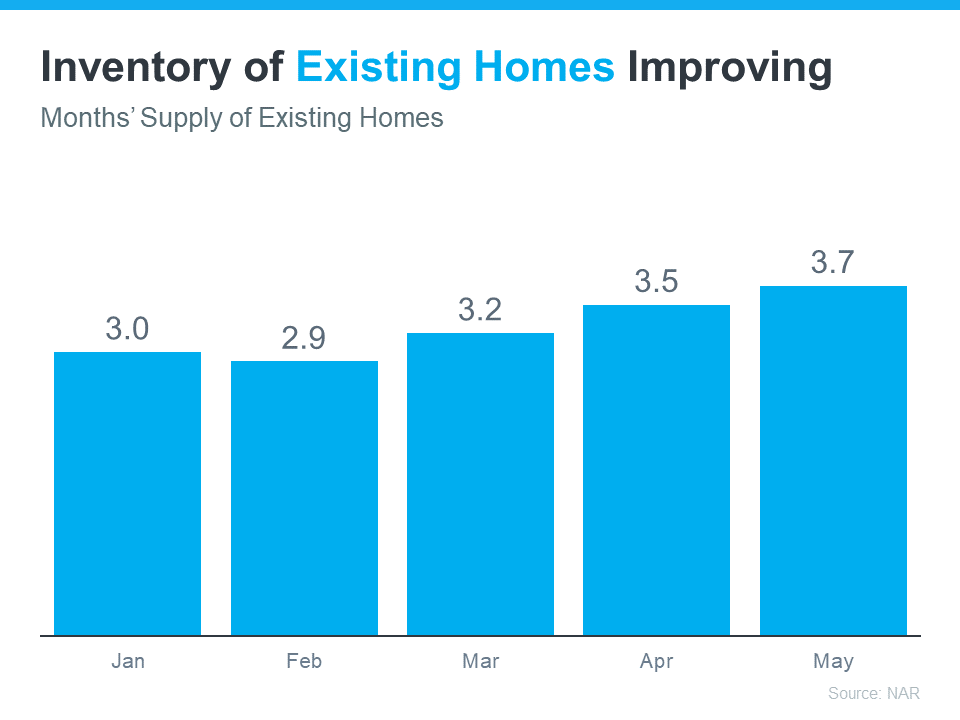
This graph shows the months’ supply of existing homes – homes that were previously lived in by another homeowner. The upward trend this year is clear.
This increase means you have a better chance of finding a home that suits your needs and preferences. And if the biggest reason you put off your home search was difficulty finding the right home, this is a big relief.
2. There’s More New Home Construction
And if you still don’t see an existing home you like, another big opportunity lies in the rise of new home construction. Builders have worked to increase the supply of newly built homes this year. And they’ve turned their attention to crafting smaller, more affordable homes based on what’s most needed in today’s market. This helps address the long-standing issue of housing undersupply throughout the country, and those smaller homes also offset some of the affordability challenges you’re feeling today.
According to data from the Census and NAR, one in three homes on the market is a newly built home (see graph below):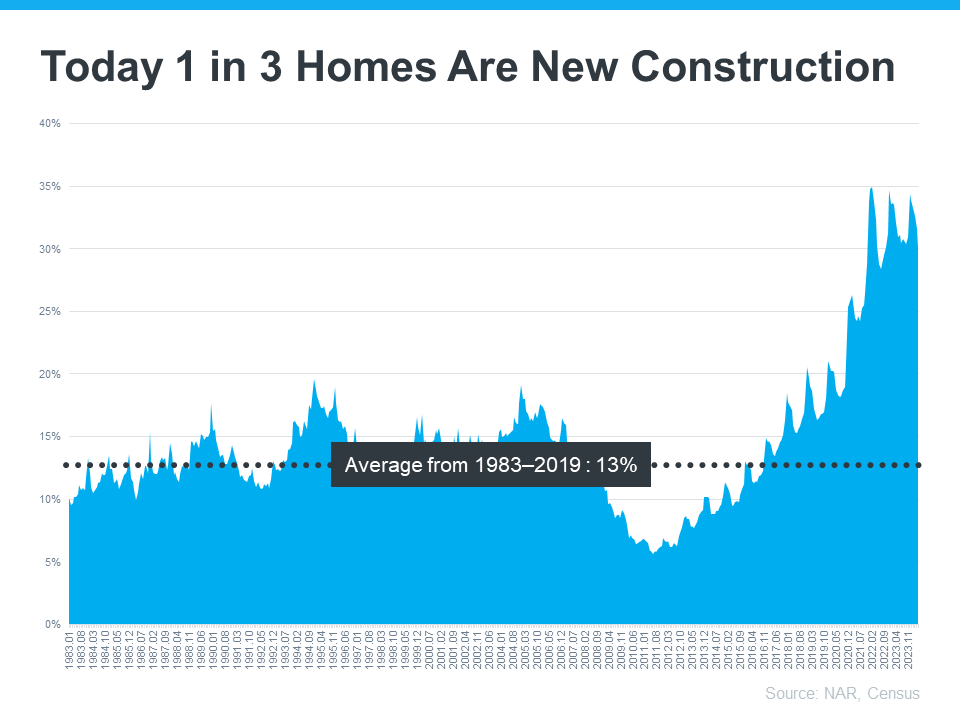
This means, that if you didn’t previously look at newly built homes as part of your search, you may have been cutting your pool of options by a third. Not to mention, some builders are also offering incentives like buying down mortgage rates to make it easier for buyers to get a home that fits their budget.
So, consider talking to your agent about what builders have to offer in your area. Your agent’s expertise on builder reputations, contracts, and more will help you weigh your options.
3. Less Buyer Competition
Mortgage rates are still hovering around 7%, so buyer demand isn’t as fierce as it once was. And when you combine that with more housing supply, you have a better chance of avoiding an intense bidding war. Danielle Hale, Chief Economist at Realtor.com, highlights the positive trend for the latter half of 2024, saying:
“Home shoppers who persist could see better conditions in the second half of the year, which tends to be somewhat less competitive seasonally, and might be even more so since inventory is likely to reach five-year highs.”
This creates a unique opportunity for you to find a home you want to buy with less stress and at a potentially better price.
4. Home Prices Are Moderating
Speaking of prices, home prices are also showing signs of moderation – and that’s a welcome shift after the rapid appreciation seen in recent years (see graph below): 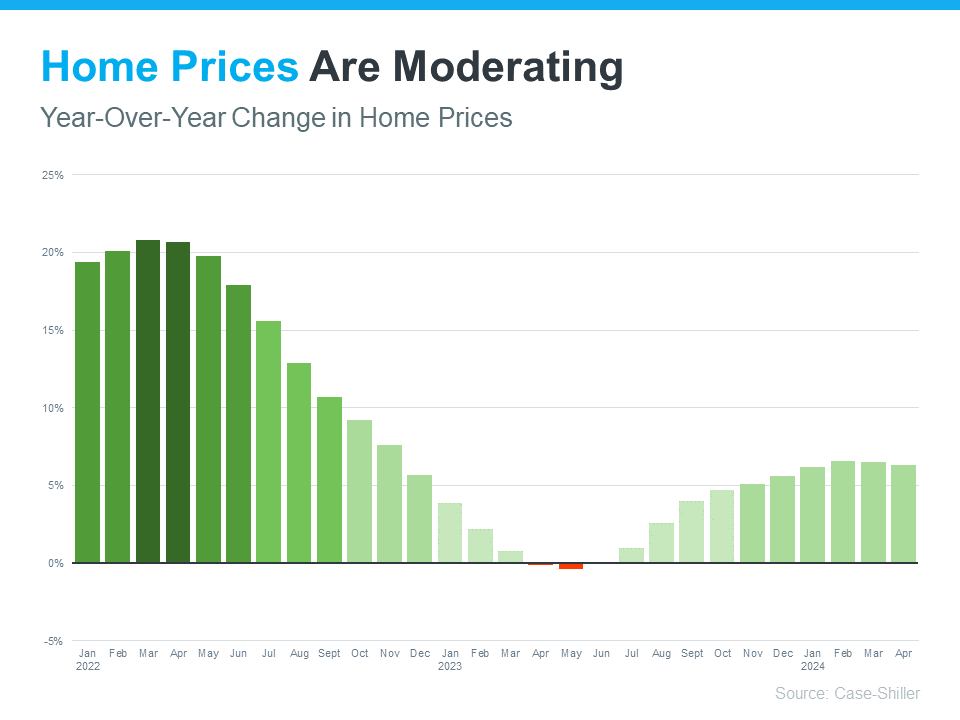
This moderation is mostly due to supply and demand. Supply is growing and demand is easing, so prices aren’t rising as fast. But make no mistake, that doesn’t mean prices are falling – they’re just rising at a more normal pace. You can see this in the graph. The bars are still showing prices increasing, just not as dramatic as it was before.
The average forecast for home price appreciation in 2024 is for positive growth around 3% to 5%, which is more in line with historical norms. That moderation means that you are less likely to face the steep price increases we saw a few years ago.
The Opportunity in Front of You
If you’re ready and able to buy, you may find that the second half of 2024 is a bit easier to navigate. There are still challenges, but some of the biggest hurdles you’ve faced are getting better as time wears on.
On the other hand, you could choose to wait. But if you do, here’s the risk you run. As more buyers recognize the shift in the market, competition will grow again. On a similar note, if mortgage rates do come down (as forecasts say), more buyers will flood back into the market. So, making a move now helps you take advantage of the current market conditions and get ahead of those other buyers.
Bottom Line
If you’ve put your dream of homeownership on hold, the second half of 2024 may be your chance to jump back in. Connect with a real estate agent to talk more about the opportunities you have in today’s market.

Student loans are back in the spotlight. And whether you’ve been following the headlines closely or just catching bits and pieces here and there, there’s a good chance they’ve been on your mind lately.
And if you’re questioning whether you have to hit pause on your plans to buy a home, here’s the thing you have to remember:
Having student loans doesn’t automatically mean buying a home has to wait.
The Biggest Myth About Student Loans and Buying a Home
One of the most common misconceptions among first-time buyers is that they have to pay off their student loans before they can qualify for a mortgage. But in most cases, that’s just not true.
As an article from Redfin explains, student loans usually get evaluated the same way other debts do, like credit cards or car payments:
“Yes, you can get a mortgage with student loan debt. Lenders primarily assess your debt-to-income (DTI) ratio, which compares your monthly debt payments, including student loans, to your gross monthly income. Having student debt doesn’t automatically disqualify you if your DTI is within acceptable limits.”
So having that loan on your credit report isn’t some special red flag that immediately disqualifies you.
Instead, lenders look at your overall financial situation, including your income, credit history, and more. Student loans are one piece of that puzzle, but they’re not the entire picture.
You’re in Better Company Than You Think
Just to really drive this home, here’s a stat from the National Association of Realtors (NAR) that proves you can have student debt and still buy a home. Their research shows 33% of first-time homebuyers still had student loan debt.
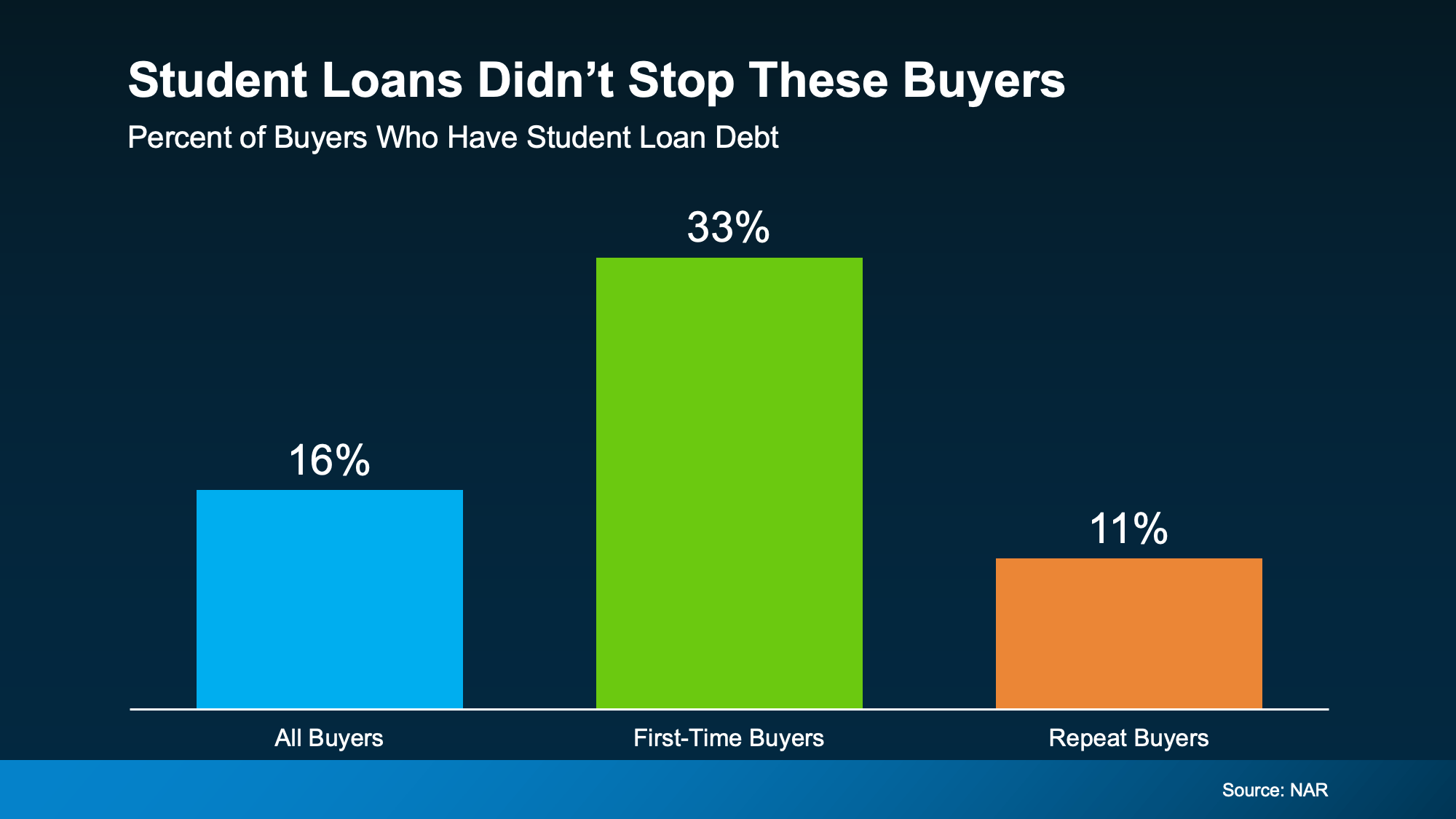
That’s 1 out of every 3 first-time buyers. The median amount they owed? $30,400.
Let that reassure you that people are buying homes with student debt every day. And carrying student loans doesn’t automatically put homeownership out of reach.
Don’t Count Yourself Out Before You Even Try
At the end of the day, here’s where a lot of buyers trip themselves up. They assume the worst and never even check what they could actually qualify for. But your situation is more unique than a blanket “no.”
If your income is steady and the rest of your finances are in decent shape, buying a home could be more realistic than you think. The only way to know for sure is to actually run the numbers with someone who does this for a living.
You may discover you’re closer to buying than you think.
Bottom Line
Student loans don’t have to be the thing standing between you and owning a home. If you’ve been putting off your homebuying plans because of that debt, talk to a lender about your options. It may not be the barrier you think it is.

Saving for a down payment can feel like the hardest part of buying a home. And with affordability as tight as it’s been lately, it’s fair to wonder how anyone manages it right now. Here’s something you may not have seen coming.
Some people are getting their foot in the door with a smaller down payment.
According to Realtor.com, the typical buyer put down about $23,400 in early 2026 – that’s around $5,000 below what was typical the year before (a 19% drop year over year). That’s the lowest down payments have been since 2021 (see graph below):
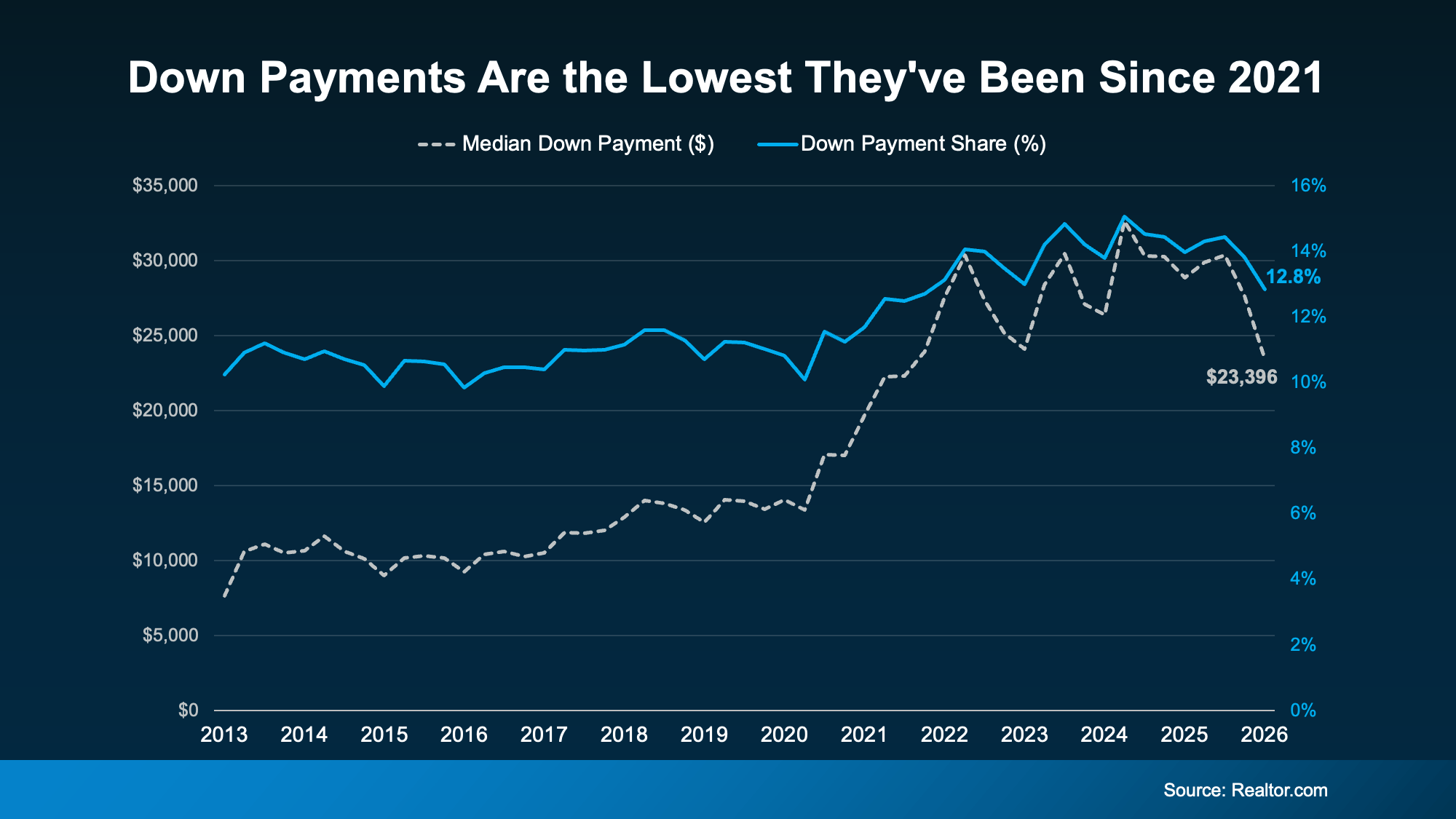
So why are buyers putting less money down, and how can you put less down, too? Here’s your answer.
Why Down Payments Are Getting Smaller
There are a few things driving the trend:
-
Less competition between buyers. Part of it comes down to a more balanced market. With buyers facing less competition than they did a few years ago, there’s less pressure to put a big sum down just to stand out.
-
More moderate home prices. Your down payment is a percentage of the purchase price. So, as price growth cools, the amount you need to put down may change too. In a lot of markets, prices have slowed or leveled off, and some areas are even seeing slight dips. That can translate into smaller down payments.
-
Buyers opting for loans with lower down payments. More buyers are also turning to government-backed loans, like FHA and VA, which often need little or no money down. FHA loans have made up more than 24% of purchase mortgages for five straight quarters, and VA loans recently hit their highest share in over a decade, according to Mortgage Professional America.
But even a smaller down payment is still a significant chunk of cash, and saving it can be hard. So where does the rest come from? For many buyers, two things make the difference: programs built to help, and a hand from loved ones.
Help You May Not Know You Qualify For
Down payment assistance is one of the most overlooked tools out there. Looking at the 10 largest U.S. metros, Urban Institute and Down Payment Resource found nearly 44% of recent buyers already qualified for a down payment program, but many of them closed on their loan without tapping the help (see chart below):
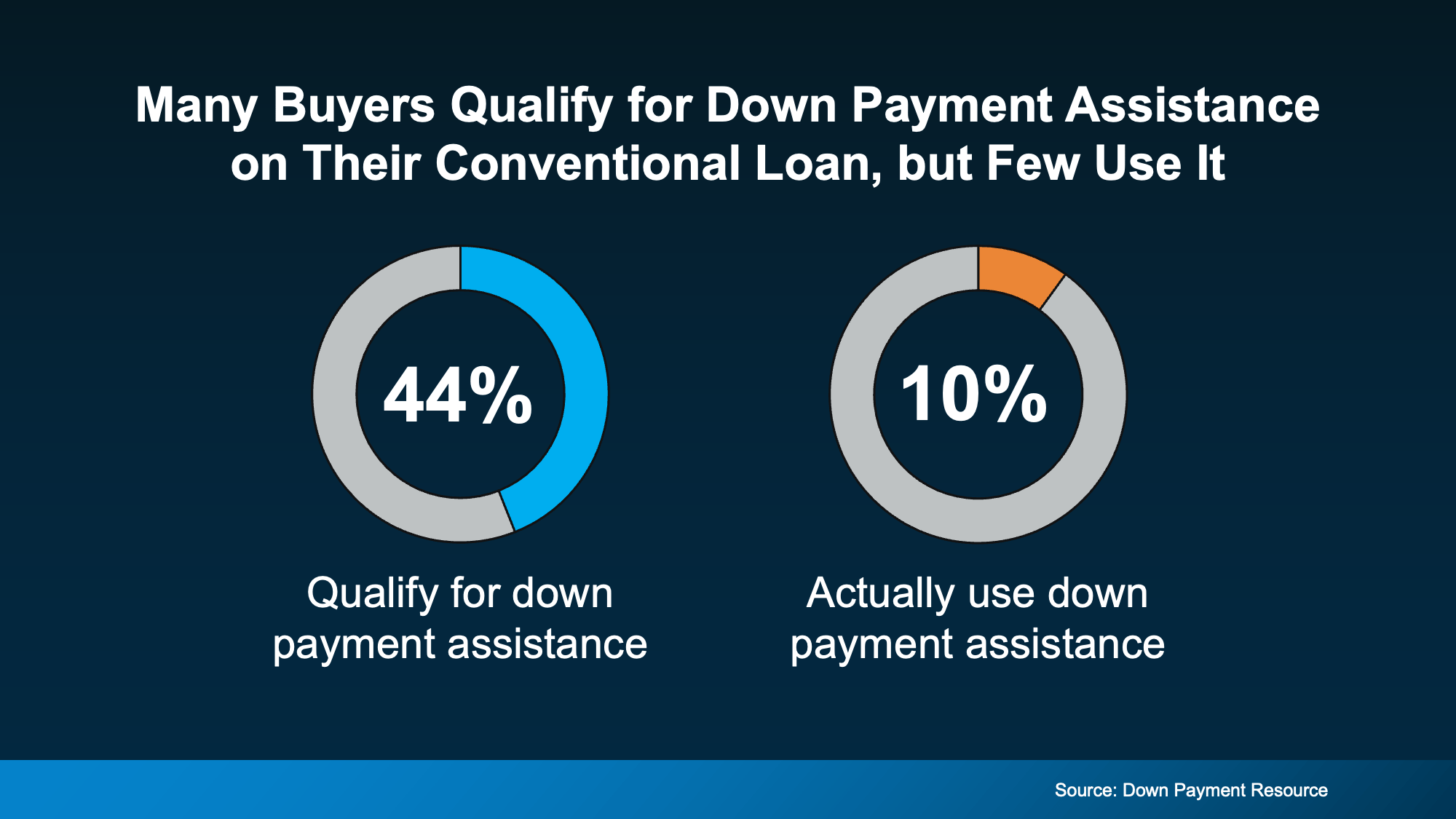
The options are broader than you might assume, too. According to Down Payment Resource:
-
There are more than 2,600 down payment assistance programs available
-
More than half (62%) are designed to help first-time buyers
-
38% have no first-time buyer requirement, so you may qualify even if you’ve owned before
-
62% are open to buyers earning $100,000 or more
A Boost from Loved Ones
For a growing number of buyers, help comes from closer to home. Research from Veterans United shows about 59% of parents have provided or plan to provide financial support to help their child buy a home.
That support most often goes toward the down payment, followed by help qualifying for a mortgage and covering closing costs. Chris Birk, VP of Mortgage Insight at Veterans United, puts it this way:
“For many families, helping a child buy a home has become less of an optional gesture and more of a practical response to today’s affordability challenges.”
If your loved ones are in a position to help, it can make a real difference in how soon you can buy.
Bottom Line
Down payments are smaller than they’ve been in years, and that opens the door for more buyers.
And with added help from assistance programs and a little help from loved ones, you may have more ways forward than you realized. Connect with a trusted lender to talk through your options.

You’ve probably heard that home prices are cooling off. And that’s true – nationally. But zoom in on individual markets across the country, and the picture looks completely different depending on where you are.
Some areas are still seeing solid price growth. Others have gone flat. A few have actually dipped slightly negative. So, what’s causing all of that variation?
It All Comes Down to Inventory
Here’s the simple version:
-
When there are more homes for sale, buyers have options.
-
More options, means less competition.
-
Less competition means sellers can’t push prices as high.
On the flip side, when inventory is tight, buyers are competing over a small pool of homes, and that pushes prices up.
That dynamic is playing out right now in a really visible way across the country.
Markets where inventory has climbed back to, or above, normal pre-pandemic levels are seeing prices flatten or fall slightly. Markets where inventory is still well below those 2019 benchmarks are still seeing prices rise. As Lance Lambert, CEO of ResiClub, puts it:
“Home prices are still climbing a little year-over-year in many regions where active inventory remains well below pre-pandemic 2019 levels, such as pockets of the Northeast and Midwest.
In contrast, some pockets in states like Texas, Florida, and Colorado — where active inventory exceeds pre-pandemic 2019 levels by a solid clip — are seeing modest home price pullbacks or flat pricing.”
The Maps Say It All
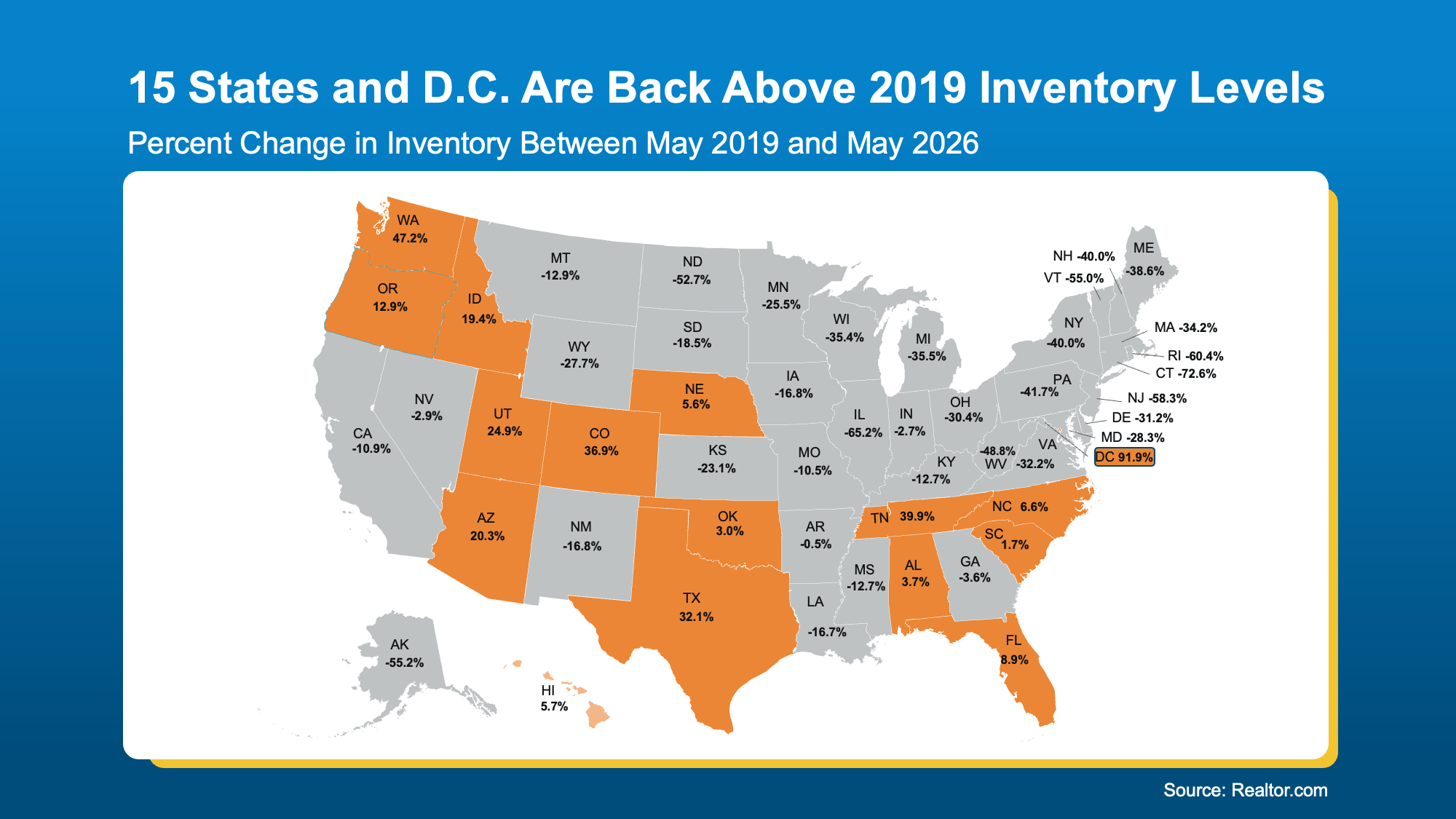
Take a look at where inventory stands today compared to 2019. In most places (the states in gray below), inventory still falls short of where we were back then. And that’s exactly why prices are climbing, albeit moderately, in the vast majority of states.
But you’re probably more interested in where prices are falling a bit, since that’s what is making headlines. So, let’s prove out how much inventory affects prices in those spots.
According to Realtor.com, 15 states and Washington, D.C. are now back above pre-pandemic inventory levels, and some by a wide margin (see the orange in the map below):
 Now, let’s look at the latest Federal Housing Finance Agency (FHFA) data to see what’s happened to home prices in those same states over the past year (again, you’ll want to focus on the orange in the next map).
See how those line up pretty closely with the areas seeing more homes for sale today?
The overlap isn’t a coincidence. It’s cause and effect.
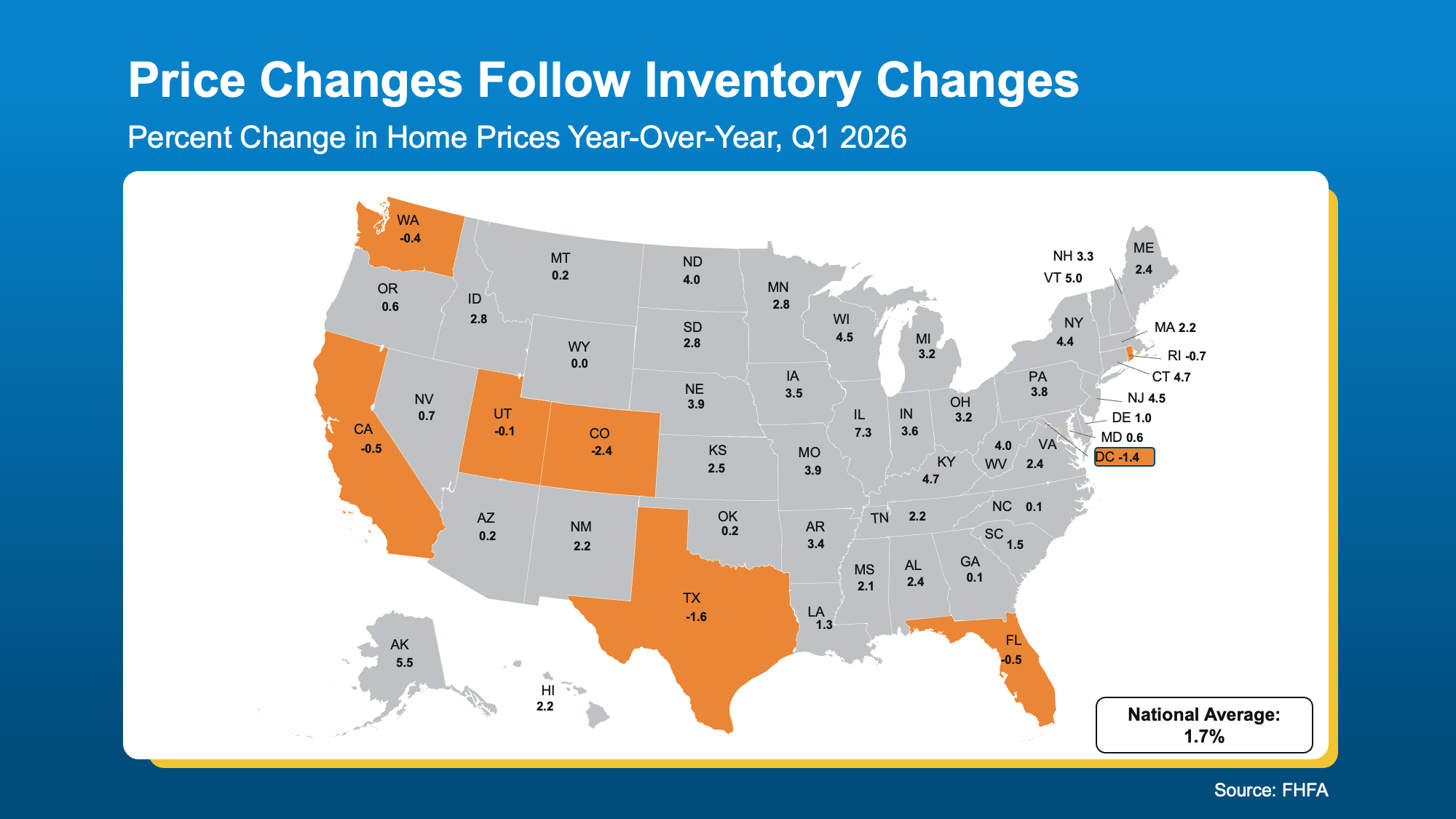
The national average of 1.7% price growth is accurate, but it’s an average of two very different stories happening at the same time – the few areas experiencing mild declines and the overwhelming majority that are still seeing prices rise.
What This Means If You’re Buying or Selling
If you’re a buyer, the market you’re shopping in matters a lot right now. In places like Texas, Colorado, or Florida, you may have real negotiating power – more choices, less competition, and sellers who are more motivated to make a deal. In tighter markets like much of the Northeast, you’re still likely facing a lot of competition.
If you’re a seller, pricing strategy is everything. In markets where inventory has risen, overpricing is one of the fastest ways to linger on the market and eventually sell for less than you would have with the right price from day one. In markets where inventory is still low, you’re in a strong spot, but getting your price right still matters if you want to attract serious buyers quickly. Either way, that’s where a local real estate agent earns their keep.
Bottom Line
When it comes to prices, where you are matters more than ever right now, and a local real estate agent is the best person to help you make sense of it.
Reach out to a local real estate agent today and work together to build a plan that fits your market.

What To Expect from the Housing Market in the Second Half of 2026

Student Loans Are Back in the News. Don’t Let It Put Your Homeownership Plans on Hold.

What Buying or Selling a Home Gives Back to Your Community



-

 For Sellers4 weeks ago
Should You Pay for Your Buyer’s Closing Costs? What Sellers Need To Know.
-

 For Buyers3 weeks ago
Think Home Prices Will Crash? Here’s What the Experts Actually Expect.
-
 Affordability3 weeks ago
That House That’s Been Sitting Could Be Your Best Shot at a Deal
-

 Economy2 weeks ago
More Sellers Are Taking Their Homes off the Market. Here’s What You Need To Know.
-

 Agent Value3 weeks ago
Is It Still a Seller’s Market? Here’s What the Data Says.
-

 Agent Value2 weeks ago
Your House Didn’t Sell. Here’s How To Turn It Around.
-

 Equity1 week ago
The Housing Market Is Stronger Than You Think
-

 Buying Tips2 weeks ago
The 1 Factor That Explains Everything Happening with Home Prices Right Now
You must be logged in to post a comment Login