


Buying Tips
Should I Buy a Home Now or Wait?

At some point, you’ve probably heard the saying: “Yesterday was the best time to buy a home, but the next best time is today.”
That’s because homeownership is about the long game – and home prices typically rise over time. So, while you may be holding out for prices to fall or rates to improve, you should know that trying to time the market rarely works.
Here’s what most buyers don’t always think about: the longer you wait, the more buying could cost you. And you deserve to understand why.
Forecasts Say Prices Will Keep Climbing
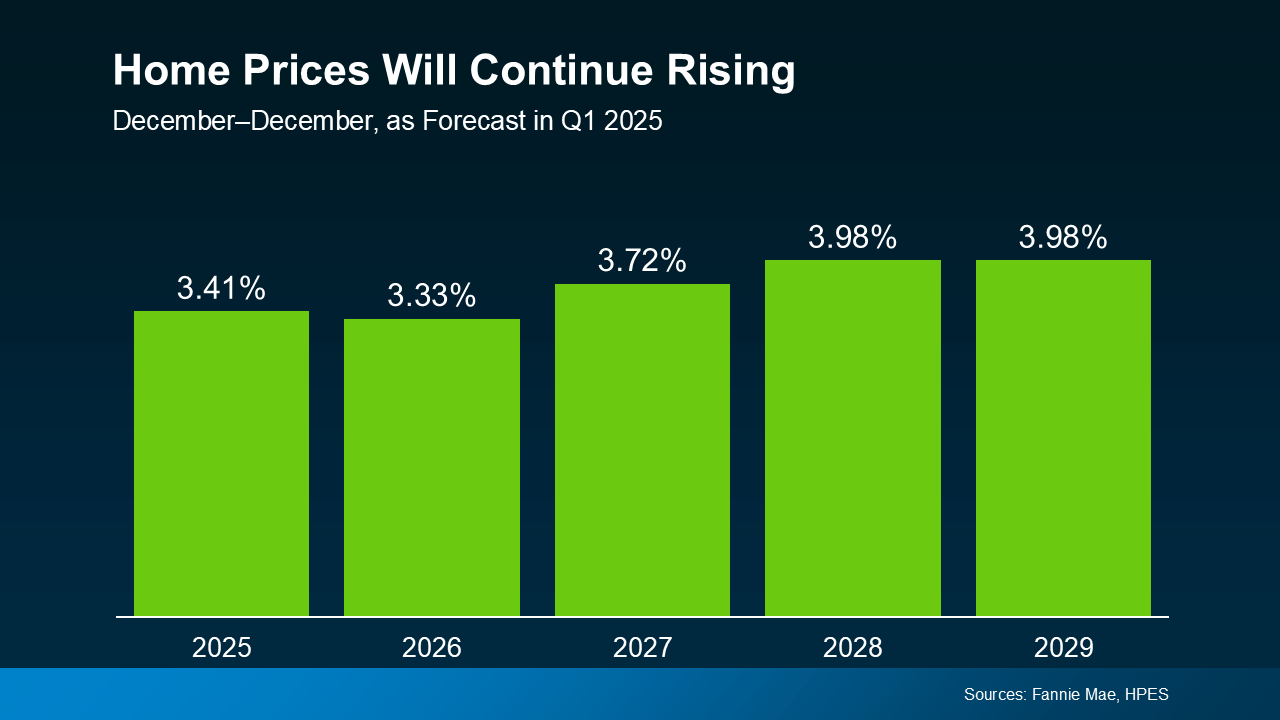
Each quarter, over 100 housing market experts weigh in for the Home Price Expectations Survey from Fannie Mae, and they consistently agree on one thing: nationally, home prices are expected to rise through at least 2029.
Yes, the sharp price increases are behind us, but experts project a steady, healthy, and sustainable increase of 3-4% per year going forward. And while this will vary by local market from year to year, the good news is, this is a much more normal pace – a welcome sign for the housing market and hopeful buyers (see graph below):
And even in markets experiencing more modest price growth or slight short-term declines, the long game of homeownership wins over time.
So, here’s what to keep in mind:
- Next year’s home prices will be higher than this year’s. The longer you wait, the more the purchase price will go up.
- Waiting for the perfect mortgage rate or a price drop may backfire. Even if rates dip slightly, projected home price growth could still make waiting more expensive overall.
- Buying now means building equity sooner. When you play the long game of homeownership, your equity rewards you over time.
What You’ll Miss Out On
Let’s put real numbers into this equation, because it adds up quickly. Based on those expert projections, if you bought a typical $400,000 home in 2025, it could gain nearly $80,000 in value by 2030 (see graph below):
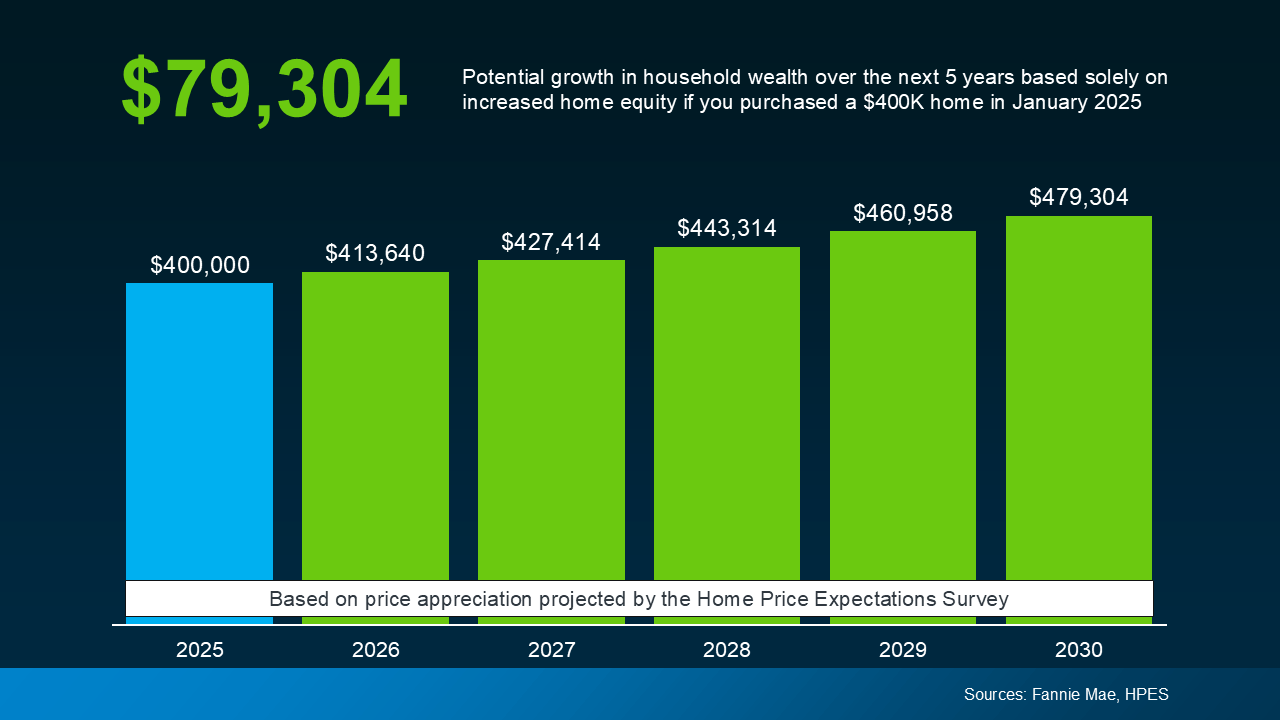 That’s a serious boost to your future wealth – and why your friends and family who already bought a home are so glad they did. Time in the market matters.
So, the question isn’t: should I wait? It’s really: can I afford to buy now? Because if you can stretch a little or you’re willing to buy something a bit smaller just to get your foot in the door, this is why it’ll be worth it.
Yes, today’s housing market has challenges, but there are ways to make it work, like exploring different neighborhoods, asking your lender about alternative financing, or tapping into down payment assistance programs.
The key is making a move when it makes sense for you, rather than waiting for a perfect scenario that may never arrive.
Bottom Line
Time in the Market Beats Timing the Market.
If you’re debating whether to buy now or wait, remember this: real estate rewards those who get in the market, not those who try to time it perfectly.
Want to take a look at what’s happening with prices in your local area? Whether you’re ready to buy now or just exploring your options, having a plan in place can set you up for long-term success.

Today’s home prices have a lot of buyers – especially first-time buyers – wondering if there’s even anything out there that’s in their budget. But owning a home may be more within reach than you think. Sometimes, it just means considering a different type of home.
Condos and townhomes can be a great way to buy without stretching every last dollar. And right now, two things make them worth a serious look.
There Are More Condos and Townhomes To Choose From
Maybe you feel like there’s just nothing out there for you, and you’ve exhausted all your options. But have you considered condos or townhomes? A lot of buyers start by looking for a single-family, detached home without even realizing what that search omits from their pool of choices.
According to HousingWire Data, there were 233,030 condos and townhomes for sale this June. That’s more than any June in at least the past decade, and more than double the number available back in 2022 (see graph below):
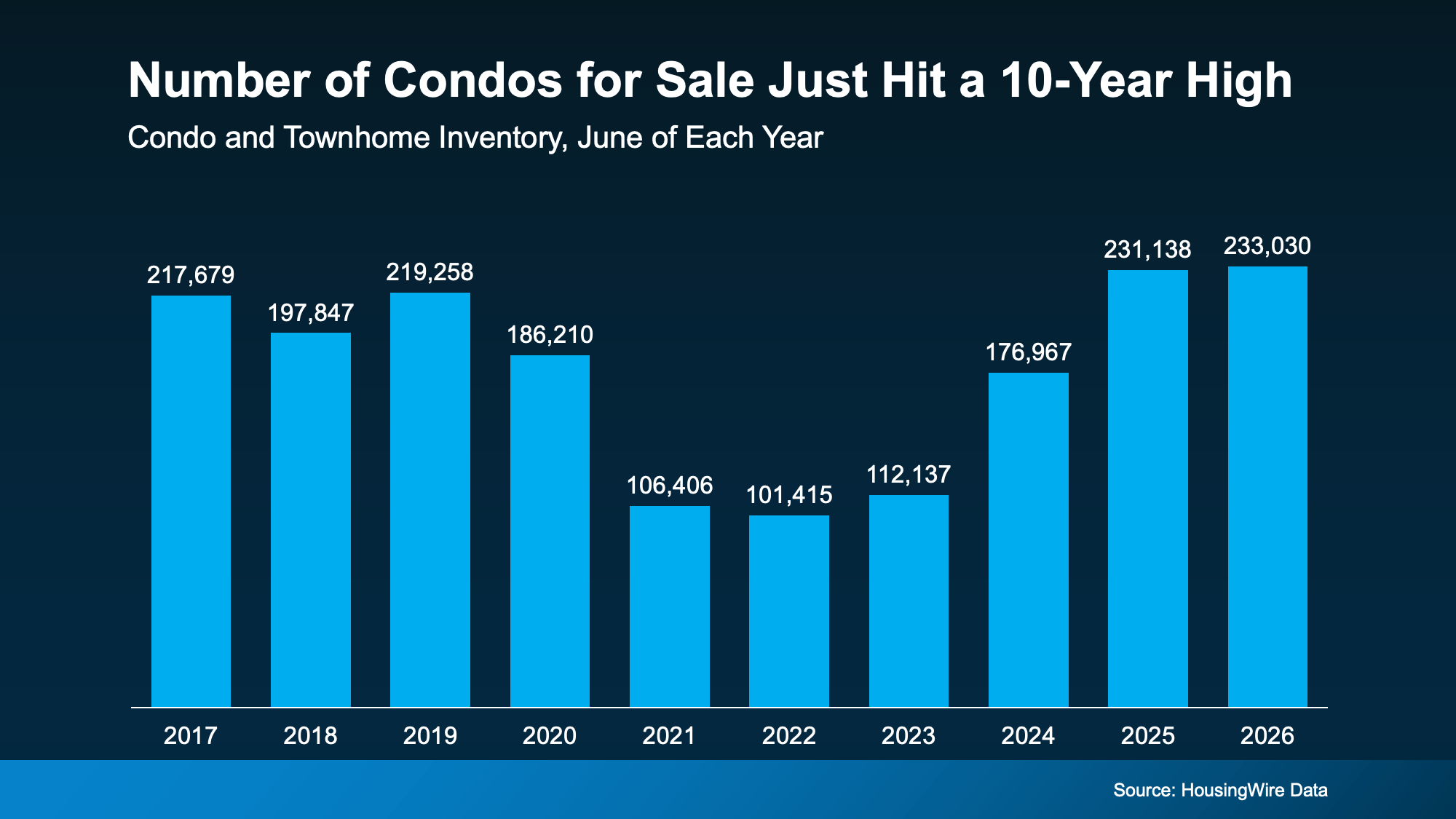
That means there are more options out there in this segment of the market – and that’s especially good news for first-time buyers. These types of homes can be a great way to break into the market for less.
Just remember, that’s the national number. What’s available will depend on where you’re looking. But generally speaking, more options means less competition, more time to decide, and more room to negotiate.
They Also Tend To Cost Less Than Single-Family Homes
Price is the other big draw. According to the National Association of Realtors (NAR), the median condo price was $380,000 in June. In contrast, the median single-family home price was $446,400 (see graph below):

That’s a difference of more than $66,000.
A big reason why? Condos are usually smaller than single-family homes. And smaller homes can come with smaller price tags.
And if you don’t need all that extra space, that lower entry price could be exactly what gets you through the door.
Condo or Townhome? How They’re Different.
For buyers who feel priced out of the market, a condo or townhome could be a way in. But there are some things to know. Before you start checking out homes, it’s good to understand how these two compare to each other – and to a single-family home.
-
With a single-family detached home, you own the house and the land it sits on, and you don’t share any walls with neighbors. That means the most space and privacy. But it also usually comes with a higher tag, and all the maintenance is on you.
-
With a townhome, you own the building and the lot it sits on. They’re usually multi-level, so you get more space, and you share two walls at most. You’ll also have more say over how your home looks and how repairs get done, but more of that upkeep falls on you.
-
With a condo, you own just the inside of your unit and may have access to community features like a pool or gym. The building and shared space belong to everyone who lives there, which means you have less maintenance responsibilities. But you’ll also likely have more neighbors around you, less control over building decisions, and higher HOA fees since the HOA handles the exterior and common areas.
Bottom Line
A condo or townhome could be your path to owning a home without blowing your budget. Connect with a local real estate agent to see what’s for sale in your area and figure out which type of home fits your lifestyle, and your bottom line.
If you’ve thought about buying a home in the past few years, you may have run into two frustrations: asking prices that kept climbing and too few homes to choose from.
In many places, both sticking points are letting up this summer, with lower asking prices and more homes for sale. Let’s look at the trends, and what they mean for your search.
Sellers Are Pricing To Attract Buyers
According to Realtor.com, the national median asking price was $430,000 in June, nearly $11,000 under what it was the year before (see graph below):
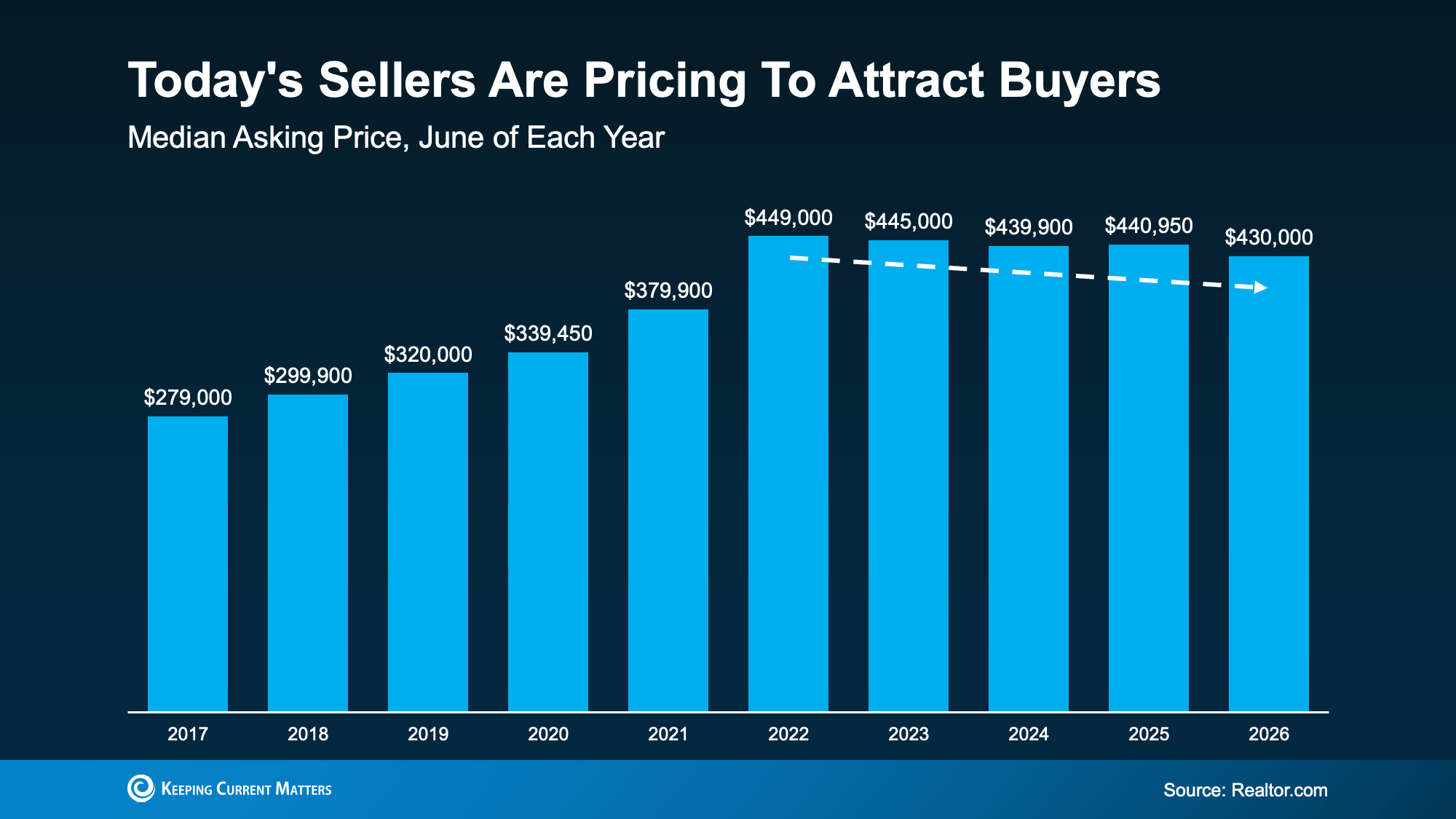
That’s the eighth month in a row that the typical asking price has dipped below where they were the previous year, according to the same Realtor.com report.
And while falling prices can sound worrying, this isn’t a sign of an impending crash. We’re talking about asking prices, not sold prices. This is a sign that today’s sellers are meeting the market where it is and pricing to draw buyers. And that’s actually something normal we’d expect from the market. As Danielle Hale, Chief Economist at Realtor.com, puts it:
“Sellers are reading market conditions and are pricing accordingly from the start rather than listing high and cutting later, and buyers are taking note and making bids. This is a welcome sign that we are in a functioning market.”
Asking prices were never going to climb forever – now they’re just settling closer to what buyers can actually pay. That signals a healthier market, and sellers re-adjusting their expectations.
More Homes Are Available Now
If you’ve spent the past few years watching homes disappear before you could even schedule a tour, this is for you.
Supply is starting to catch up. According to Realtor.com, the number of homes listed for sale in June was the highest June number we’ve seen in three years (see graph below):
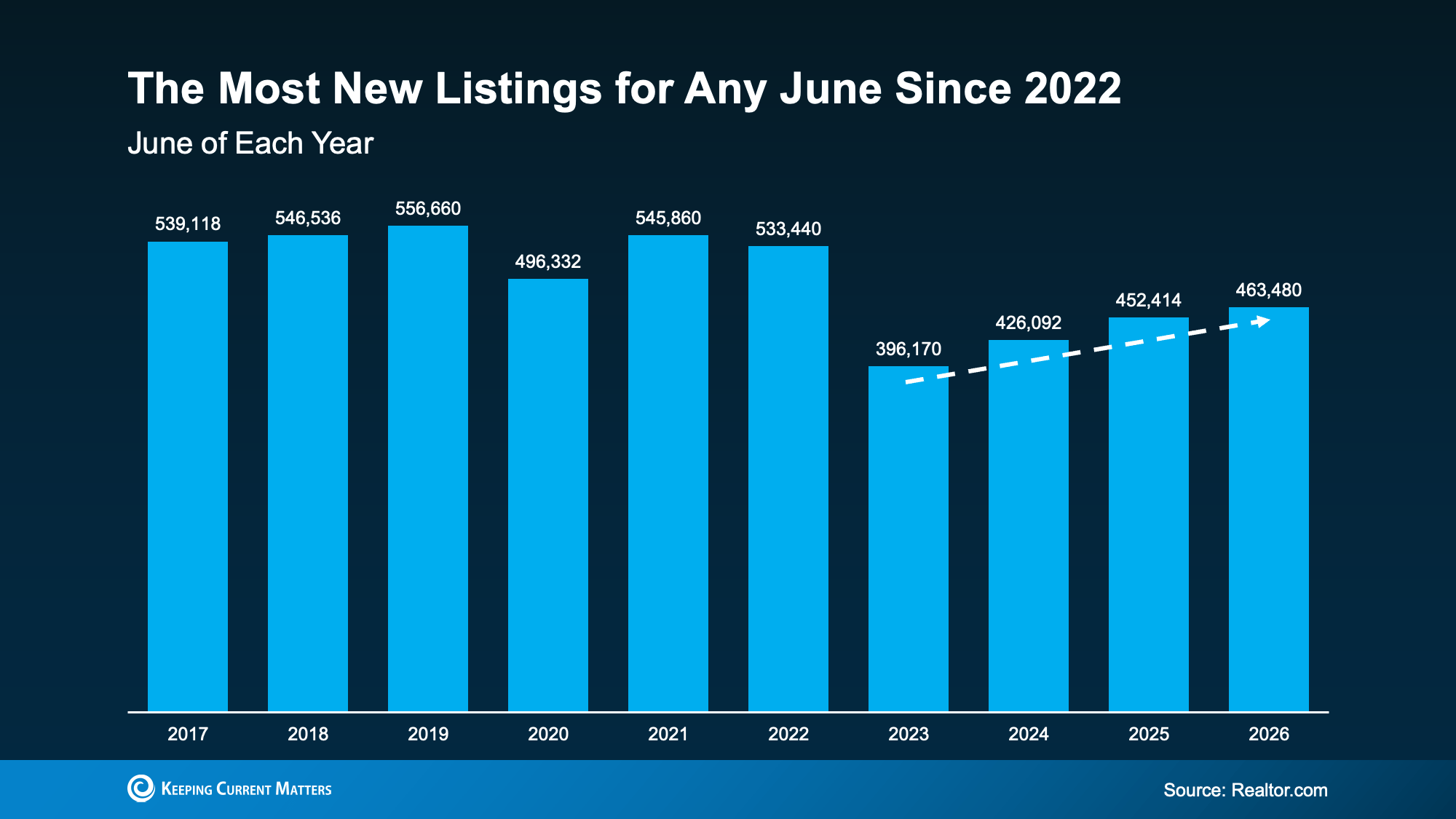
This means more options for you and less competition for each one.
Now, supply is not back to normal everywhere. As you can see, we’re still down from where we were back in 2017-2019. But in many places, it’s better than it’s been in a while. Here’s how that helps you.
You don’t have to rush an offer just to stay in the running, and you have better odds of finding and landing the right home, not just the one that’s available. Plus, you’ll have more room to negotiate, so you’re searching from a stronger position than buyers had even a year ago.
Why This Is Encouraging if You’re Buying Your First Home
For first-time buyers looking for lower-priced homes, these trends line up especially well. Mischa Fisher, Chief Economist at Zillow, explains:
“The lowest price tiers are exhibiting some softness in terms of price, they also had the most listing-activity growth, the first time since 2022 that’s been the case.”
So, if you’re searching for your first place or your next house, there’s a little more to choose from and a little more give on price.
Bottom Line
If a tight budget or a thin selection has kept you from buying a home, now might be the time to restart your search.
Connect with a local real estate agent to see what’s available where you’re looking.

Negotiations are back. More buyers are asking for better deals, and more sellers are giving them. Builders are throwing in extras, too.
That’s why whether you’re buying or selling today, there are two terms you’ll hear a lot: concession and incentive.
-
A concession is something a seller agrees to during negotiations to get a deal done.
-
An incentive is a perk a builder (or a seller) advertises upfront to attract buyers.
Let’s run through what you need to know about both and how they could play a role in your move.
More Sellers Are Agreeing to Concessions
Almost half (46%) of homeowners who sold recently gave the buyer a concession, according to Redfin. That’s the highest share on record for this time of year. And roughly 1 in 7 (16%) sellers went a step further, cutting their asking price and offering a concession on top (see chart below):
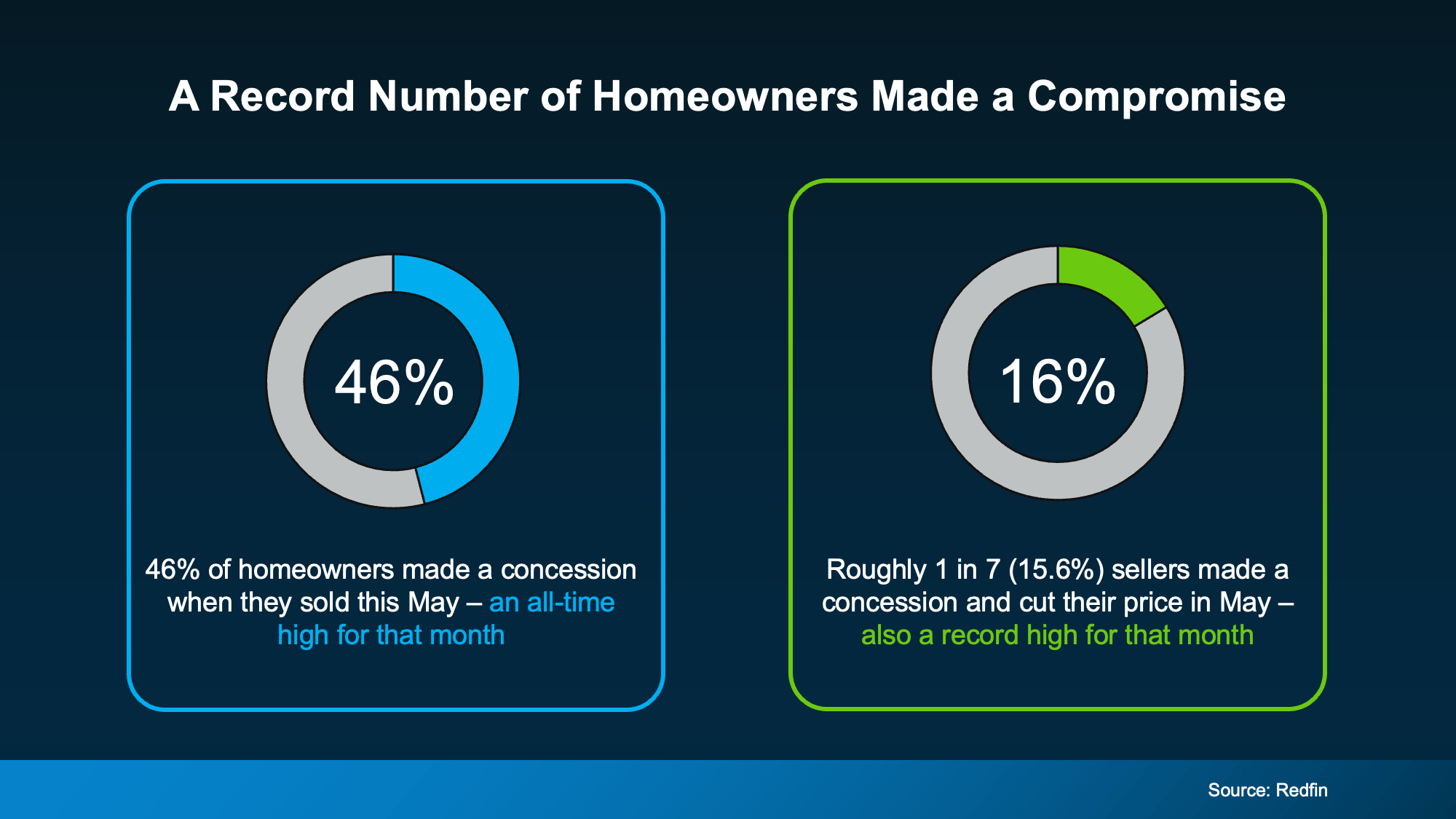
So, what kind of concessions are we talking about?
A seller might cover part of your closing costs, take care of a repair, or offer a credit that trims your upfront costs. It’s how they keep a deal on track when buyers have more options to choose from – and homeowners aren’t the only ones compromising.
Builders Are Cutting Prices, Too
Newly built homes are seeing the same push and pull. According to the National Association of Home Builders (NAHB), 62% of builders are offering incentives right now. And about 35% are cutting prices outright (see chart below):
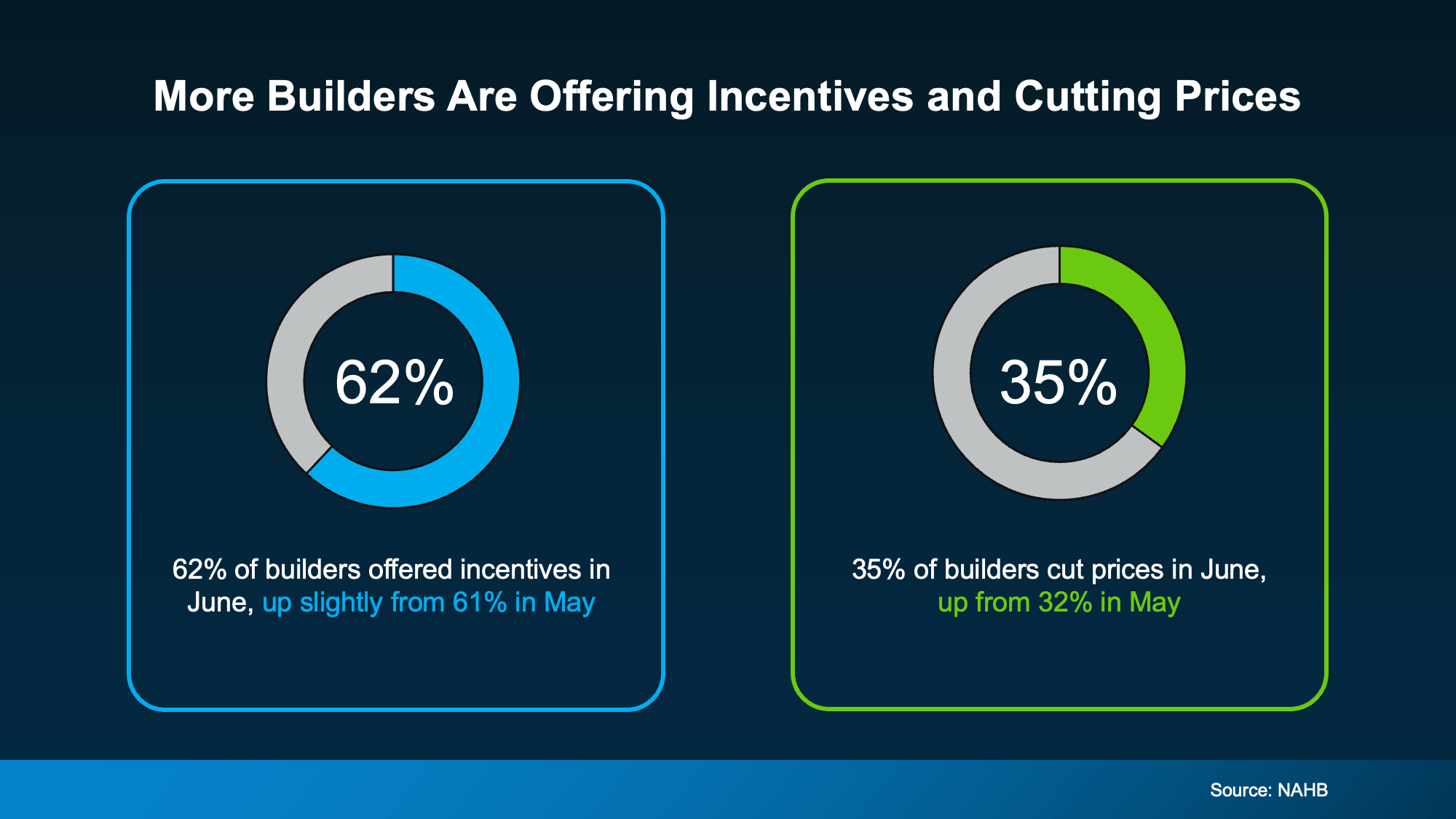
Those incentives often look like:
-
Mortgage rate buydowns
-
Free upgrades, like nicer finishes or appliances
Danielle Hale, Chief Economist at Realtor.com, explains why:
“New construction has been one of the steadiest parts of the housing market over the past few years, but builders are clearly responding to today’s affordability pressures and higher levels of existing-home inventory.”
Even builders, who many people think rarely negotiate, are competing on price and perks. They have been for over a year now. The same data shows this is the 15th straight month where more than 60% of builders have offered incentives to sweeten the deal. And that’s significant.
What This Means for Your Move
If you’re buying, this is a good time to ask. Whether you have your eye on an existing house or a newly built home, there’s a chance the seller or builder will meet you partway on price, terms, or both.
If you’re selling, expect buyers to ask. Even builders of brand-new homes are making concessions more often than not right now. Holding firm on every term could mean more time on the market, or a lost sale altogether.
Bottom Line
Sellers and builders are both giving buyers more to work with this year. A local agent can tell you what to expect in concessions and incentives based on inventory and competition in your local market.

The House That Started It All Could Kickstart What’s Next

Priced Out? A Condo or Townhome Could Be Your Way In.

More Homes, Better Prices: A Buyer’s Summer



-
 Agent Value4 weeks ago
Your House Didn’t Sell. Here’s How To Turn It Around.
-
 Equity3 weeks ago
The Housing Market Is Stronger Than You Think
-
 Economy3 weeks ago
What Buying or Selling a Home Gives Back to Your Community
-
 Buying Tips4 weeks ago
The 1 Factor That Explains Everything Happening with Home Prices Right Now
-

 Affordability3 weeks ago
Down Payments Are Smaller Than They’ve Been Since 2021
-

 Buying Tips2 weeks ago
Student Loans Are Back in the News. Don’t Let It Put Your Homeownership Plans on Hold.
-

 Affordability2 weeks ago
What To Expect from the Housing Market in the Second Half of 2026
-

 Buying Tips2 weeks ago
The “Take It or Leave It” Attitude Is Fading from the Market – What That Means for You
You must be logged in to post a comment Login