


First-Time Buyers
The Credit Score Myth That’s Holding Would-Be Buyers Back

Would-be homebuyers aren’t sitting on the sidelines because they don’t want to buy. They’re sitting out because they think they can’t. And sometimes, it’s their credit score that’s holding them back.
According to a Bankrate survey, 2 out of every 5 (42%) Americans believe you need excellent credit to qualify for a mortgage. That may be why, when renters are asked why they don’t own yet, “my credit isn’t good enough” comes up often.
Maybe you’re in the same boat. You look at your score, see it’s not where you want it to be, and assume buying your first place just isn’t realistic right now.
But here’s what you need to know.
Even though a lot of people assume you need flawless credit to buy a house, that’s not necessarily the case.
You Don’t Need Perfect Credit To Buy a Home
So, where’s this myth come from? Part of the confusion stems from the fact that the typical homebuyer today does have a fairly strong credit score. In fact, according to data from the NY Fed, the median credit score for all buyers is 775.
But that doesn’t mean you need a score that high to qualify.
Looking at recent homebuyers, a number were able to get a mortgage with scores below that threshold. Data shows 10% of scores were around 660. Which means some were higher than that and some were lower, but the median in that lowest 10th percentile was around that range (see graph below):
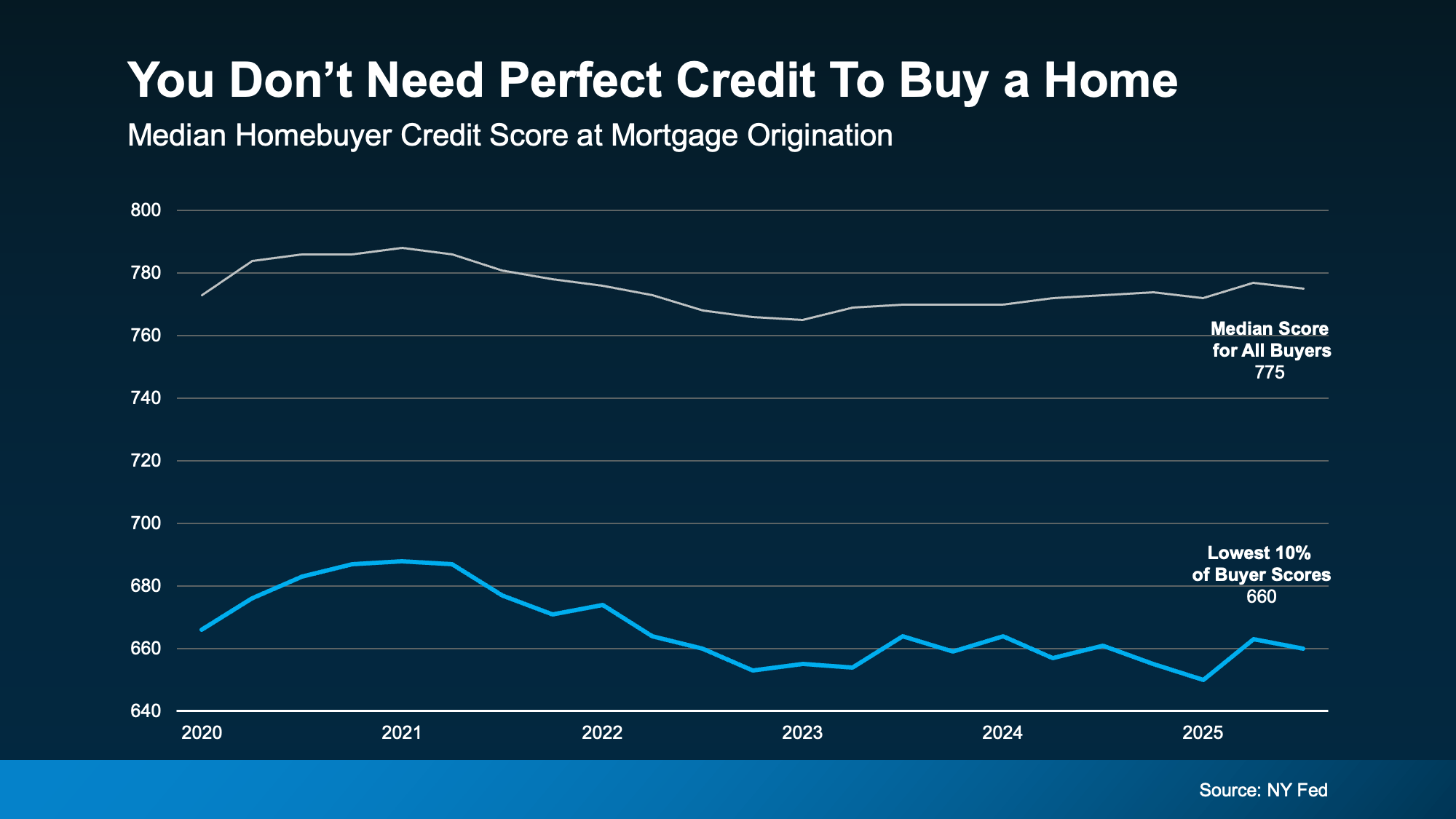 So, even if your score isn’t as high as you want, that doesn’t automatically close the door. FICO explains there is no universal credit score you absolutely have to have when buying a home:
“While many lenders use credit scores like FICO Scores to help them make lending decisions, each lender has its own strategy, including the level of risk it finds acceptable. There is no single ‘cutoff score’ used by all lenders, and there are many additional factors that lenders may use . . .”
The best thing to do is to talk to a trusted lender to see what’s possible for you. Because a portion of buyers are buying with scores in the 600s – and maybe that means you can too.
Bottom Line
Your credit score is important. But that doesn’t mean it has to be perfect.
If credit has been the reason you’ve been waiting to buy a home, it might be time to take another look at your options. If you want help understanding where you stand and what your next step could be, connect with a local lender.
You don’t need to have everything figured out to start the conversation.

For the past few years, affordability has been what’s stopped a lot of buyers in their tracks. Maybe it stopped you, too.
At some point you probably did the math, looked at the monthly payment, and decided to pause your search and wait for things to get better. But here’s something you may have missed while you’ve been sitting on the sidelines.
Over the last year, housing affordability has improved in all 50 states. Yes, you read that right. It’s gotten better in every single state.
That’s based on new research coming out of First American. And while housing is still fairly expensive compared to historical standards, the pressure buyers felt over the last few years is finally starting to ease.
Some Areas Are Seeing Bigger Improvements
The first thing you need to know is that this isn’t just happening in one region or in a small handful of cities. The trend is happening almost everywhere.
Sure, individual states, cities, and even neighborhoods are going to vary – sometimes by a lot. But overall, more buyers are able to buy again. And in 48 of the top 50 metros, affordability has improved over the past year.
That same research breaks down which cities are seeing the biggest gains:
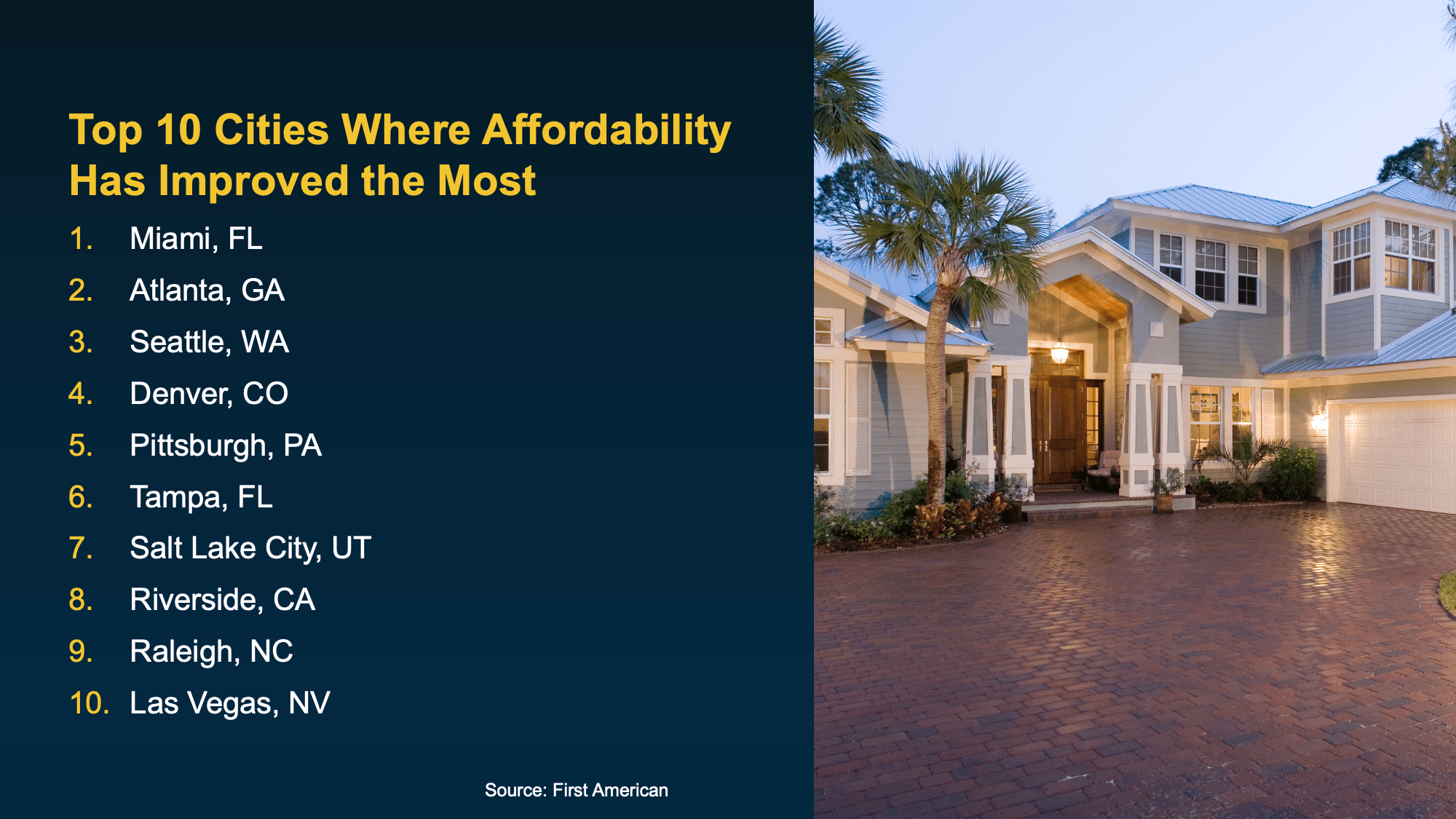 Just in case you’re wondering: why these areas? It’s simple. In many cases, it comes down to the number of homes for sale.
When buyers have more choices, it creates a healthier balance in the market and that can help bring affordability back within reach. With homes up for grabs, it opens the door a bit wider for buyers to negotiate with sellers for credits, price cuts, and more. And it gives you more chances to find a house that works for your needs and budget.
It may make more of a difference than you think.
None of this means affordability challenges have completely disappeared. Buying a home is still a big financial decision. But the trend is moving in a direction many buyers have been waiting for.
As Chen Zhao, Head of Economic Research at Redfin, puts it:
“The housing affordability crisis is showing signs of easing . . . opening the door for more Americans to make the jump to homeownership.”
Bottom Line
If you were holding off on buying, this could be exactly the signal you’ve been waiting so long for. To find out how much affordability’s improved in your area, connect with a local real estate agent.


Mortgage rates have already dropped into the upper 5s twice this year. But after just a few days, they ticked back up into the low 6% range. If you saw that and thought, “Great. I missed it,” you’re not the only one.
A lot of buyers are treating the 5s like some kind of magic number. As if moving from 6.1% to 5.99% suddenly changes everything. And from a mindset perspective, it does feel different.
But here’s the part most people don’t actually run the math on.
The Payment Difference Isn’t What You Think
Let’s say you’re looking at a $500,000 home loan. At 6.1%, generally speaking, your principal and interest payment is roughly $3,030 per month. At 5.9%, it’s about $2,966 per month.
That’s a difference of only $64 a month.
Not $300.
Not $500.
Sixty dollars.
Let that sink in for just a moment.
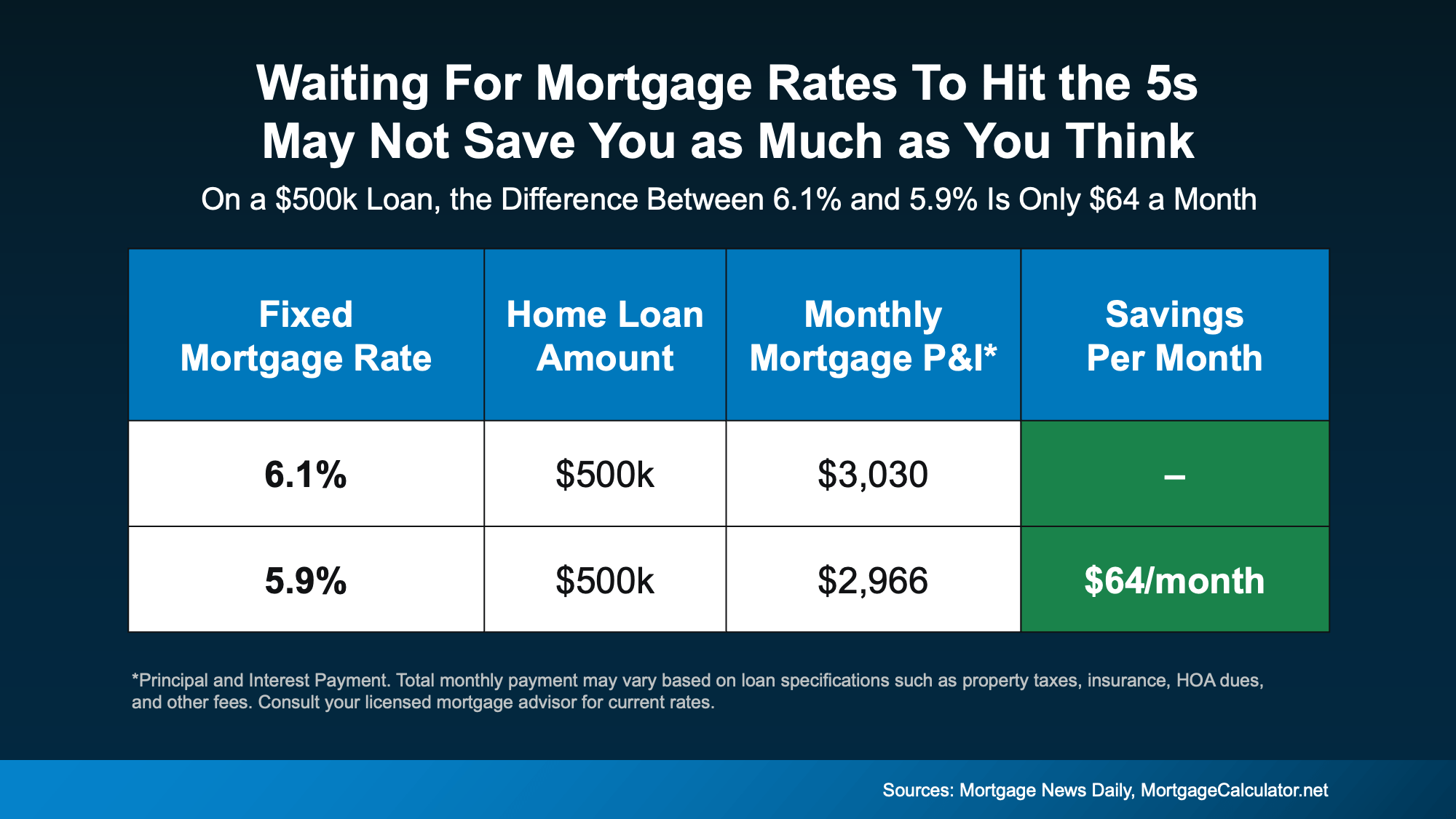 Yes, over time that $64 a month can add up. But it’s far from the dramatic swing many buyers imagine when they say they’re “waiting for the 5s.”
The psychological impact of seeing a 5 in front of your rate can feel big. The financial impact? It might be something you don’t even notice when it’s all said and done.
Experts Aren’t Predicting a Big Drop
Another important piece to think about: most housing economists aren’t forecasting a long-term return to 5% territory anytime soon.
While rates will move up and down, likely hitting the high 5s here and there, the broader expectation is for mortgage rates to hover in the low 6% range this year, not stay in the 5’s or decline much more.
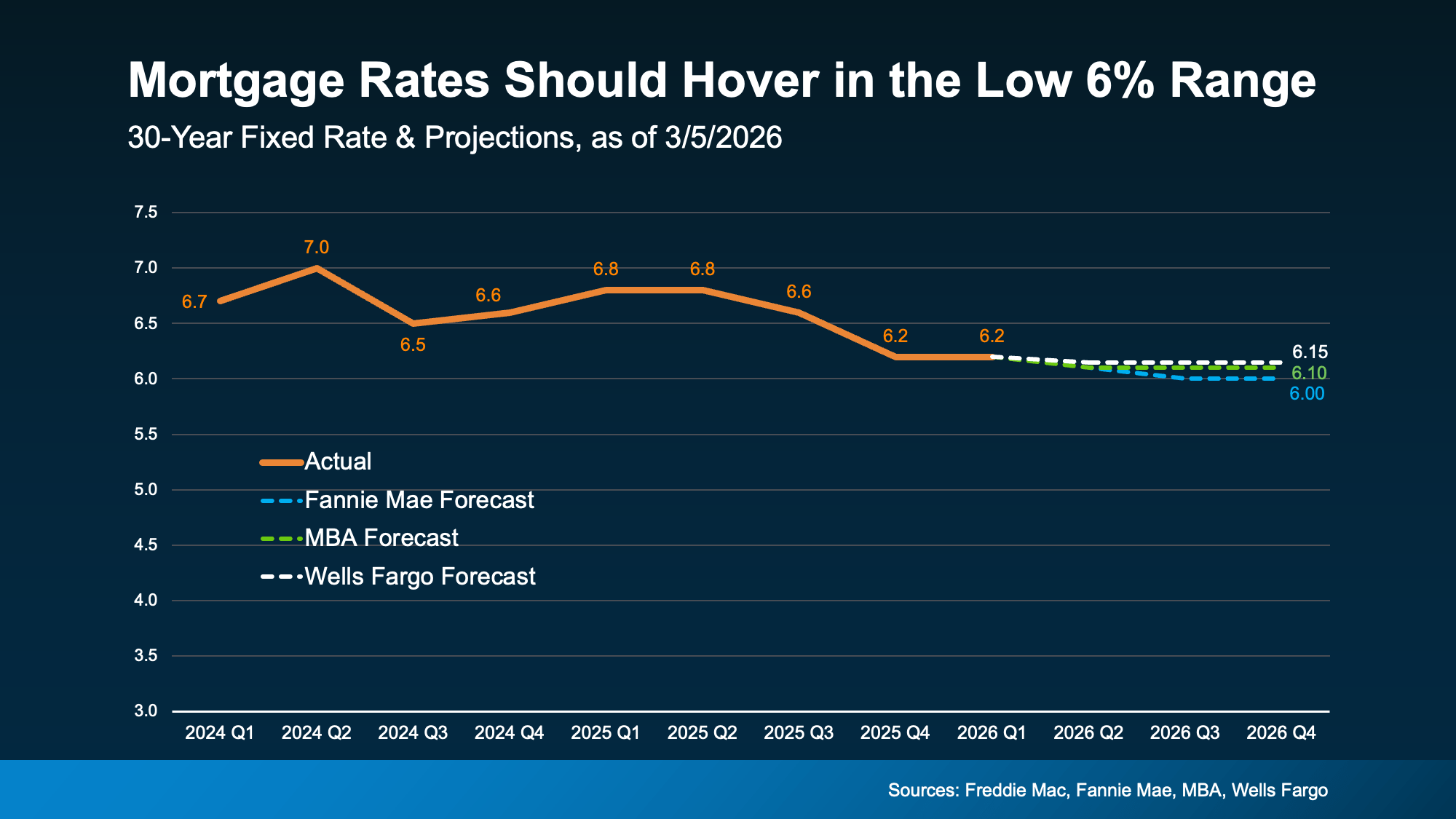 While it certainly could happen, the reality is, waiting for a deep drop may not deliver the payoff you’re hoping for, if you’re holding out
The Bigger Question to Ask
Instead of asking, “Did I miss the 5s?” A better question is: “Does today’s payment work for me?”
If the monthly payment fits comfortably in your budget, and you’ve found a home that meets your needs, the difference between 6.1% and 5.9% likely isn’t the deciding factor. It might be one of them, but it shouldn’t be everything.
And remember, mortgage rates aren’t permanent. If they drop meaningfully later, refinancing is always an option. But you can’t refinance a home you didn’t buy.
Waiting Might Feel Safe, But It Isn’t Always Strategic
It’s natural to want the best possible rate. Everyone does. But sometimes buyers overestimate how much a rate in the high 5s will change things in today’s market.
Don’t miss the fact that rates have already come down. A year ago, they were in the 7s. Now? They’re hovering in the low 6s. And for a lot of people, that percentage point difference that’s already here is the real game changer.
If you paused your plans when rates were higher, now may be the right time to re-run your numbers. Not because rates are “perfect.” But because the monthly payment math might work better than you think, even with rates in the low 6s.
Before assuming you’ve missed your moment, take another look at the numbers.
You may find it never disappeared.
Bottom Line
If you’ve been sitting on the sidelines waiting for that magic five number for rates, that strategy may not pay off as much as you’d expect.
Connect with an agent or lender so you can double check the math at your price point. You may realize payments are already within your range.

Affordability Has Improved in All 50 States

3 Must-Do’s for First-Time Home Buyers

The #1 Reason Buyers Walk Away (And How To Get Ahead of It)



-

 Affordability3 weeks ago
Renting vs. Buying: The Numbers Might Surprise You
-

 For Sellers3 weeks ago
Top Mistakes Homeowners Are Making in 2026 (And How To Avoid Them)
-

 Equity4 weeks ago
How Your Equity Could Help Younger Generations Buy a Home
-

 Downsize3 weeks ago
The Hidden Advantage Repeat Buyers Have Right Now
-

 For Sellers2 weeks ago
Spring Sellers Have an Edge. Here’s Why.
-

 Equity2 weeks ago
Are Home Prices Dropping? Here’s the Real Story.
-

 Agent Value1 week ago
If Your House Isn’t Getting Offers, Read This.
-

 Affordability2 weeks ago
Should You Wait for Lower Rates?
You must be logged in to post a comment Login